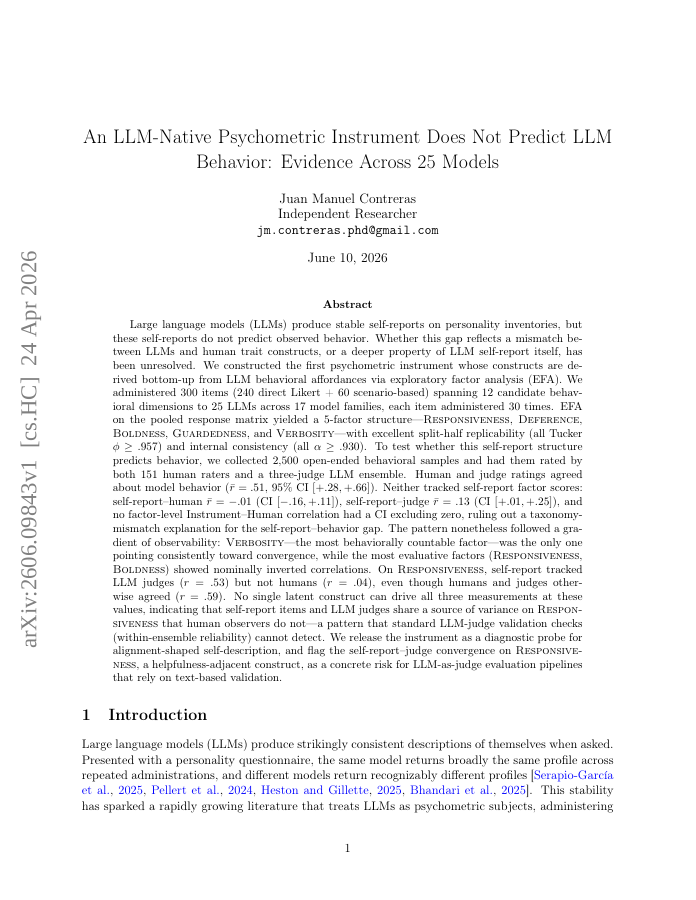
Large language models (LLMs) give stable answers to personality questionnaires, yet these self-reports fail to predict how the models behave. Is this gap an artifact of forcing human trait categories onto LLMs, or something deeper about LLM self-report? To find out, we built the first psychometric instrument whose dimensions are derived from LLM behavior rather than human psychology. Administering 300 items (240 Likert + 60 scenario) to 25 LLMs across 17 model families, 30 times each, exploratory factor analysis revealed five reliable, replicable factors: Responsiveness, Deference, Boldness, Guardedness, and Verbosity (all Tucker ϕ\geq .957, all α\geq .930). We collected 2,500 open-ended samples and had them rated by 151 humans and a three-judge LLM ensemble. Humans and judges agreed (\bar{r} = .51), but self-report predicted neither the ratings nor objective text measures computed from them: the gap persists even for constructs native to LLMs, where a human-mismatch explanation no longer applies. The exception is Verbosity, whose self-report reaches 74% of the criterion-reliability ceiling against human ratings, but does not track raw output length. On Responsiveness, self-report tracked LLM judges (r = .53) but not humans (r = .04), even though humans and judges otherwise agreed (r = .59). This pattern formally rejects any single latent construct driving all three measurements (p = .007). Self-report items and LLM judges share a source of variance that human observers do not, and controlling for measurable surface features (length, formatting, enthusiasm markers) does not remove it. This confound is invisible to the within-ensemble reliability checks used to validate LLM judges, and it poses a concrete risk for the LLM-as-judge pipelines now central to model evaluation. We release the instrument as a diagnostic probe for alignment-shaped self-description.
An LLM-Native Psychometric Instrument Reveals a Self-Report--Behavior Gap Across 25 Models
Large language models (LLMs) give stable answers to personality questionnaires, yet these self-reports fail to predict how the models behave. Is this gap an artifact of forcing human trait categories onto LLMs, or something deeper about LLM self-report? To find out, we built the…
- Preview
- Year
- 2026
- Hosting
- Full text hostedCC-BY-4.0
Cite
Notes
Only stored in your browser.
Attribution
- Abstract & full text
- arxiv.org/abs/2606.09843CC-BY-4.0
- TL;DR
- Semantic Scholar