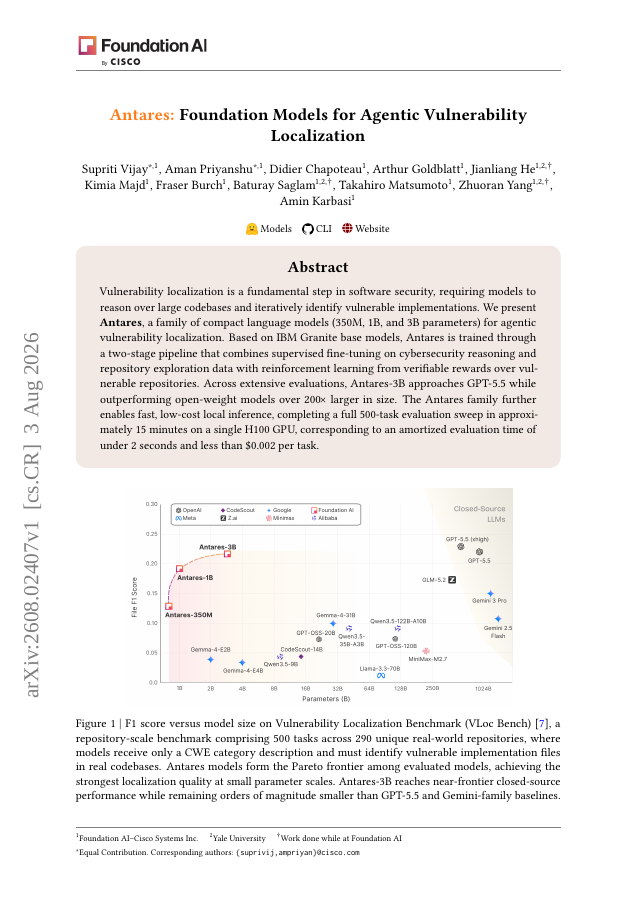
Vulnerability localization is a fundamental step in software security, requiring models to reason over large codebases and iteratively identify vulnerable implementations. We present Antares, a family of compact language models (350M, 1B, and 3B parameters) for agentic vulnerability localization. Based on IBM Granite base models, Antares is trained through a two-stage pipeline that combines supervised fine-tuning on cybersecurity reasoning and repository exploration data with reinforcement learning from verifiable rewards over vulnerable repositories. Across extensive evaluations, Antares-3B approaches GPT-5.5 while outperforming open-weight models over 200x larger in size. The Antares family further enables fast, low-cost local inference, completing a full 500-task evaluation sweep in approximately 15 minutes on a single H100 GPU, corresponding to an amortized evaluation time of under 2 seconds and less than $0.002 per task.
Antares: Foundation Models for Agentic Vulnerability Localization
Vulnerability localization is a fundamental step in software security, requiring models to reason over large codebases and iteratively identify vulnerable implementations.
- Preview
- Year
- 2026
- Hosting
- Full text hostedCC-BY-4.0
Cite
Notes
Only stored in your browser.
Attribution
- Abstract & full text
- arxiv.org/abs/2608.02407CC-BY-4.0
- TL;DR
- Semantic Scholar