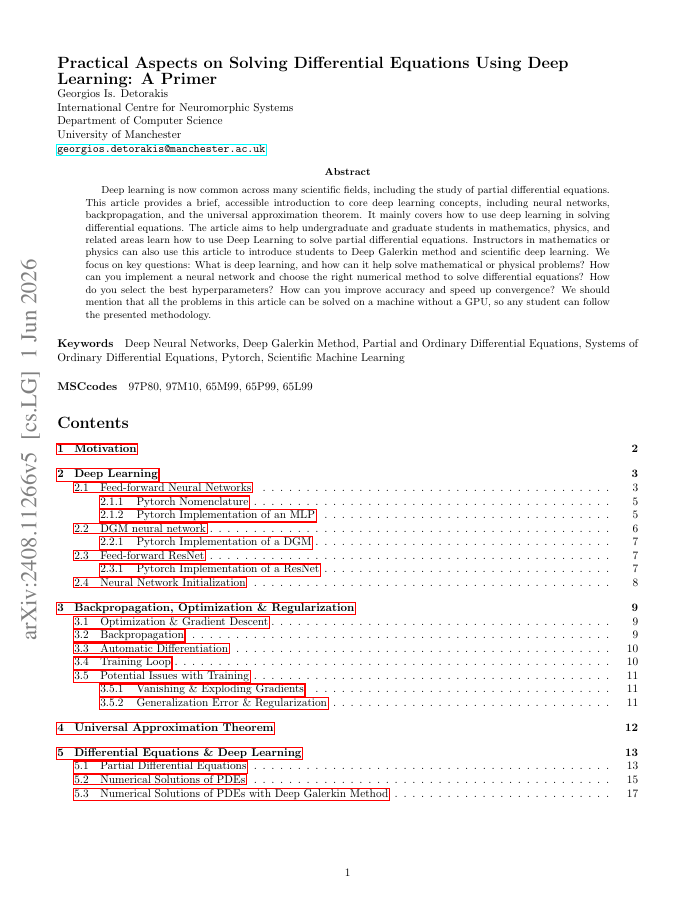
Deep learning is now common across many scientific fields, including the study of partial differential equations. This article provides a brief, accessible introduction to core deep learning concepts, including neural networks, backpropagation, and the universal approximation theorem. It mainly covers how to use deep learning in solving differential equations. The article aims to help undergraduate and graduate students in mathematics, physics, and related areas learn how to use Deep Learning to solve partial differential equations. Instructors in mathematics or physics can also use this article to introduce students to Deep Galerkin method and scientific deep learning. We focus on key questions: What is deep learning, and how can it help solve mathematical or physical problems? How can you implement a neural network and choose the right numerical method to solve differential equations? How do you select the best hyperparameters? How can you improve accuracy and speed up convergence? We should mention that all the problems in this article can be solved on a machine without a GPU, so any student can follow the presented methodology.
Practical Aspects on Solving Differential Equations Using Deep Learning: A Primer
Deep learning is now common across many scientific fields, including the study of partial differential equations. This article provides a brief, accessible introduction to core deep learning concepts, including neural networks, backpropagation, and the universal approximation…
- Preview
- Year
- 2024
- Hosting
- Full text hostedCC-BY-SA-4.0
Cite
Notes
Only stored in your browser.
Attribution
- Abstract & full text
- arxiv.org/abs/2408.11266CC-BY-SA-4.0
- TL;DR
- Semantic Scholar