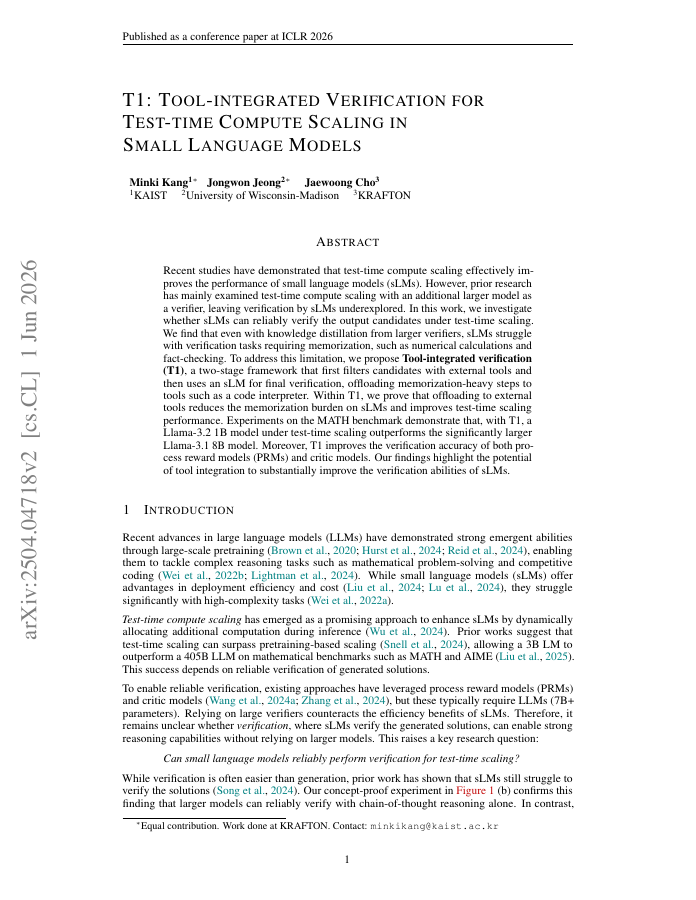
Recent studies have demonstrated that test-time compute scaling effectively improves the performance of small language models (sLMs). However, prior research has mainly examined test-time compute scaling with an additional larger model as a verifier, leaving verification by sLMs underexplored. In this work, we investigate whether sLMs can reliably verify the output candidates under test-time scaling. We find that even with knowledge distillation from larger verifiers, sLMs struggle with verification tasks requiring memorization, such as numerical calculations and fact-checking. To address this limitation, we propose Tool-integrated verification (T1), a two-stage framework that first filters candidates with external tools and then uses an sLM for final verification, offloading memorization-heavy steps to tools such as a code interpreter. Within T1, we prove that offloading to external tools reduces the memorization burden on sLMs and improves test-time scaling performance. Experiments on the MATH benchmark demonstrate that, with T1, a Llama-3.2 1B model under test-time scaling outperforms the significantly larger Llama-3.1 8B model. Moreover, T1 improves the verification accuracy of both process reward models (PRMs) and critic models. Our findings highlight the potential of tool integration to substantially improve the verification abilities of sLMs.
T1: Tool-integrated Verification for Test-time Compute Scaling in Small Language Models
Recent studies have demonstrated that test-time compute scaling effectively improves the performance of small language models (sLMs). However, prior research has mainly examined test-time compute scaling with an additional larger model as a verifier, leaving verification by sLMs…
- Preview
- Year
- 2025
- Hosting
- Full text hostedCC-BY-4.0
Cite
Notes
Only stored in your browser.
Attribution
- Abstract & full text
- arxiv.org/abs/2504.04718CC-BY-4.0
- TL;DR
- Semantic Scholar