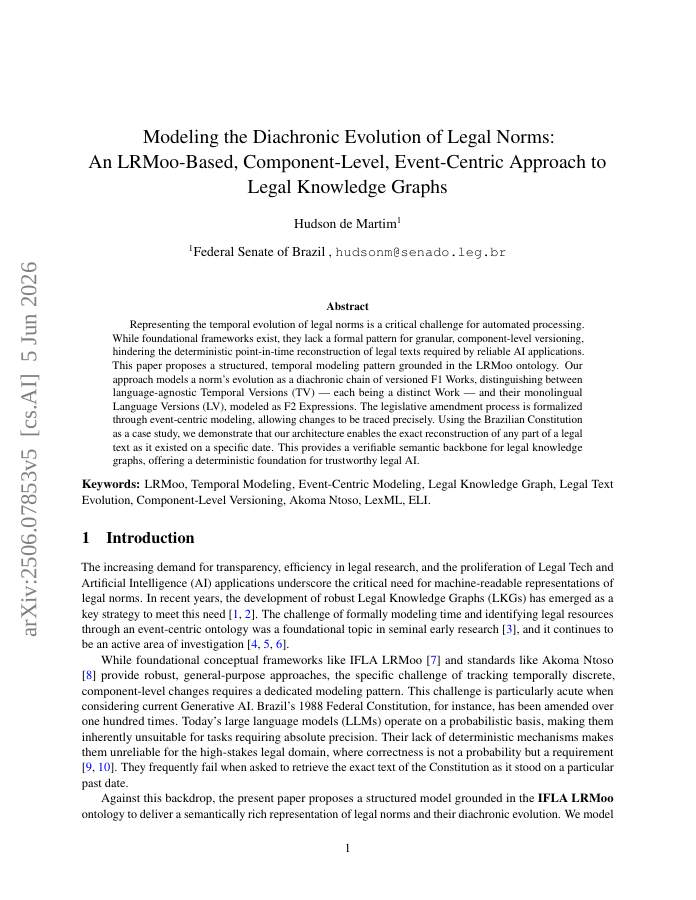
Representing the temporal evolution of legal norms is a critical challenge for automated processing. While foundational frameworks exist, they lack a formal pattern for granular, component-level versioning, hindering the deterministic point-in-time reconstruction of legal texts required by reliable AI applications. This paper proposes a structured, temporal modeling pattern grounded in the LRMoo ontology. Our approach models a norm's evolution as a diachronic chain of versioned F1 Works, distinguishing between language-agnostic Temporal Versions (TV), each being a distinct Work, and their monolingual Language Versions (LV), modeled as F2 Expressions. The legislative amendment process is formalized through event-centric modeling, allowing changes to be traced precisely. Using the Brazilian Constitution as a case study, we demonstrate that our architecture enables the exact reconstruction of any part of a legal text as it existed on a specific date. This provides a verifiable semantic backbone for legal knowledge graphs, offering a deterministic foundation for trustworthy legal AI.
Modeling the Diachronic Evolution of Legal Norms: An LRMoo-Based, Component-Level, Event-Centric Approach to Legal Knowledge Graphs
Representing the temporal evolution of legal norms is a critical challenge for automated processing. While foundational frameworks exist, they lack a formal pattern for granular, component-level versioning, hindering the deterministic point-in-time reconstruction of legal texts…
- Preview
- Year
- 2025
- Hosting
- Full text hostedCC-BY-4.0
Cite
Notes
Only stored in your browser.
Attribution
- Abstract & full text
- arxiv.org/abs/2506.07853CC-BY-4.0
- TL;DR
- Semantic Scholar