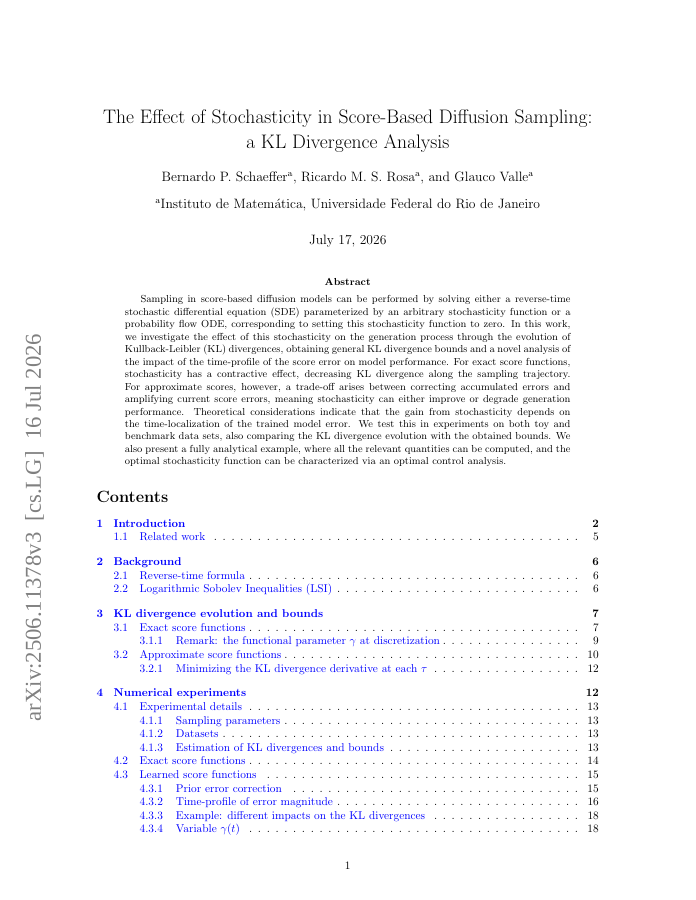
Sampling in score-based diffusion models can be performed by solving either a reverse-time stochastic differential equation (SDE) parameterized by an arbitrary stochasticity function or a probability flow ODE, corresponding to setting this stochasticity function to zero. In this work, we investigate the effect of this stochasticity on the generation process through the evolution of Kullback-Leibler (KL) divergences, obtaining general KL divergence bounds and a novel analysis of the impact of the time-profile of the score error on model performance. For exact score functions, stochasticity has a contractive effect, decreasing KL divergence along the sampling trajectory. For approximate scores, however, a trade-off arises between correcting accumulated errors and amplifying current score errors, meaning stochasticity can either improve or degrade generation performance. Theoretical considerations indicate that the gain from stochasticity depends on the time-localization of the trained model error. We test this in experiments on both toy and benchmark data sets, also comparing the KL divergence evolution with the obtained bounds. We also present a fully analytical example, where all the relevant quantities can be computed, and the optimal stochasticity function can be characterized via an optimal control analysis.
The Effect of Stochasticity in Score-Based Diffusion Sampling: a KL Divergence Analysis
Sampling in score-based diffusion models can be performed by solving either a reverse-time stochastic differential equation (SDE) parameterized by an arbitrary stochasticity function or a probability flow ODE, corresponding to setting this stochasticity function to zero.
- Preview
- Year
- 2025
- Hosting
- Full text hostedCC-BY-4.0
Cite
Notes
Only stored in your browser.
Attribution
- Abstract & full text
- arxiv.org/abs/2506.11378CC-BY-4.0
- TL;DR
- Semantic Scholar