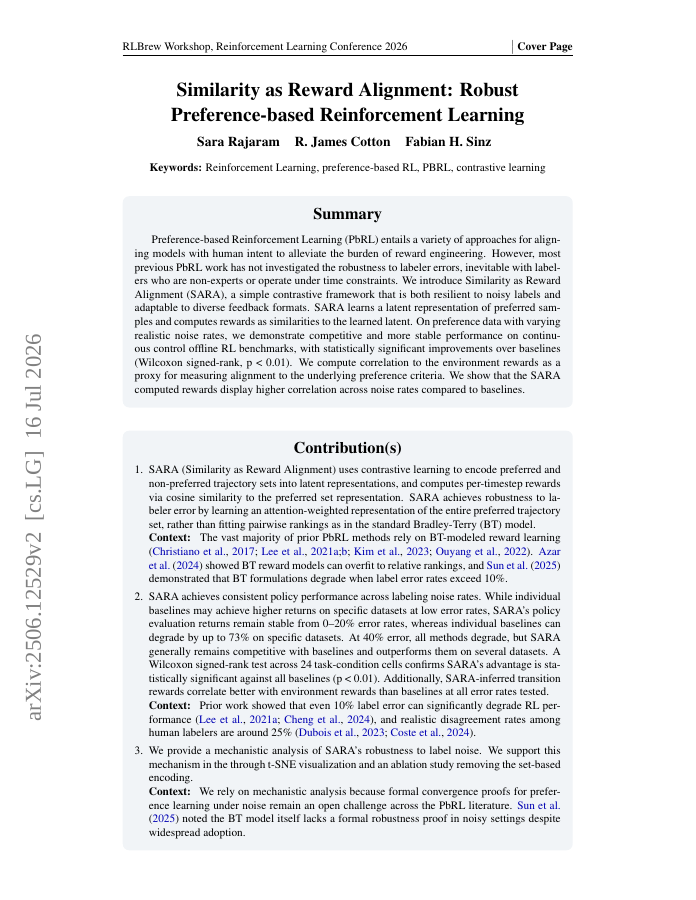
Preference-based Reinforcement Learning (PbRL) entails a variety of approaches for aligning models with human intent to alleviate the burden of reward engineering. However, most previous PbRL work has not investigated the robustness to labeler errors, inevitable with labelers who are non-experts or operate under time constraints. We introduce Similarity as Reward Alignment (SARA), a simple contrastive framework that is both resilient to noisy labels and adaptable to diverse feedback formats. SARA learns a latent representation of preferred samples and computes rewards as similarities to the learned latent. On preference data with varying realistic noise rates, we demonstrate competitive and more stable performance on continuous control offline RL benchmarks, with statistically significant improvements over baselines (Wilcoxon signed-rank, p < 0.01). We also compute correlation to the environment rewards as a proxy for measuring alignment to the underlying preference criteria. We show that the SARA computed rewards display higher correlation across noise rates compared to baselines.
Similarity as Reward Alignment: Robust and Versatile Preference-based Reinforcement Learning
Preference-based Reinforcement Learning (PbRL) entails a variety of approaches for aligning models with human intent to alleviate the burden of reward engineering. However, most previous PbRL work has not investigated the robustness to labeler errors, inevitable with labelers…
- Preview
- Year
- 2025
- Hosting
- Full text hostedCC-BY-4.0
Cite
Notes
Only stored in your browser.
Attribution
- Abstract & full text
- arxiv.org/abs/2506.12529CC-BY-4.0
- TL;DR
- Semantic Scholar