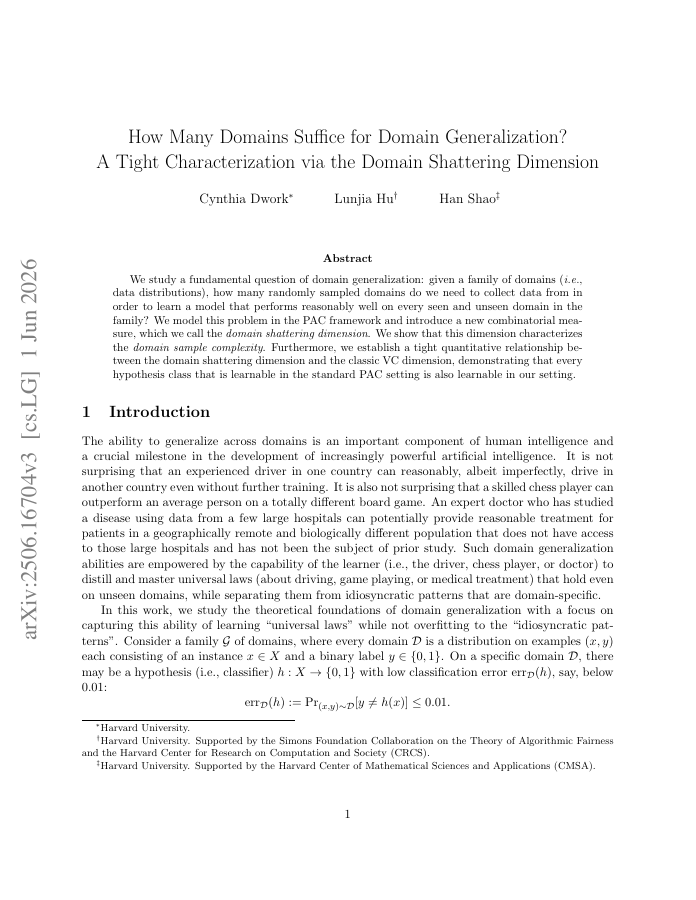
We study a fundamental question of domain generalization: given a family of domains (i.e., data distributions), how many randomly sampled domains do we need to collect data from in order to learn a model that performs reasonably well on every seen and unseen domain in the family? We model this problem in the PAC framework and introduce a new combinatorial measure, which we call the domain shattering dimension. We show that this dimension characterizes the domain sample complexity. Furthermore, we establish a tight quantitative relationship between the domain shattering dimension and the classic VC dimension, demonstrating that every hypothesis class that is learnable in the standard PAC setting is also learnable in our setting.
How Many Domains Suffice for Domain Generalization? A Tight Characterization via the Domain Shattering Dimension
We study a fundamental question of domain generalization: given a family of domains (i.e., data distributions), how many randomly sampled domains do we need to collect data from in order to learn a model that performs reasonably well on every seen and unseen domain in the…
- Preview
- Year
- 2025
- Hosting
- Abstract onlyARXIV-DEFAULT
Cite
Notes
Only stored in your browser.
Attribution
- Abstract & full text
- arxiv.org/abs/2506.16704ARXIV-DEFAULT
- TL;DR
- Semantic Scholar