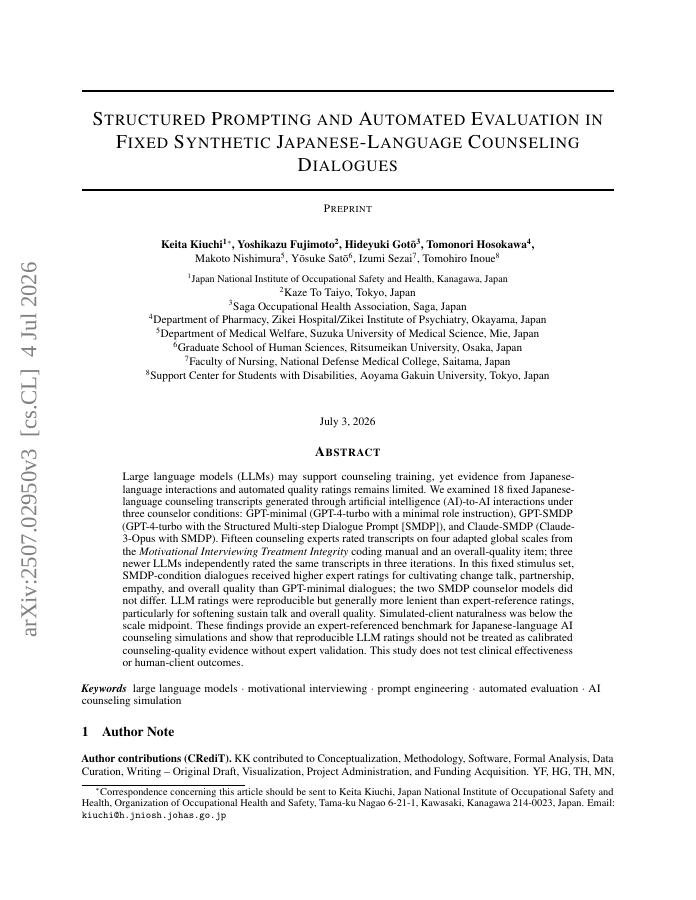
Large language models (LLMs) may support counseling training, yet evidence from Japanese-language interactions and automated quality ratings remains limited. We examined 18 fixed Japanese-language counseling transcripts generated through artificial intelligence (AI)-to-AI interactions under three counselor conditions: GPT-minimal (GPT-4-turbo with a minimal role instruction), GPT-SMDP (GPT-4-turbo with the Structured Multi-step Dialogue Prompt [SMDP]), and Claude-SMDP (Claude-3-Opus with SMDP). Fifteen counseling experts rated transcripts on four adapted global scales from the Motivational Interviewing Treatment Integrity coding manual and an overall-quality item; three newer LLMs independently rated the same transcripts in three iterations. In this fixed stimulus set, SMDP-condition dialogues received higher expert ratings for cultivating change talk, partnership, empathy, and overall quality than GPT-minimal dialogues; the two SMDP counselor models did not differ. LLM ratings were reproducible but generally more lenient than expert-reference ratings, particularly for softening sustain talk and overall quality. Simulated-client naturalness was below the scale midpoint. These findings provide an expert-referenced benchmark for Japanese-language AI counseling simulations and show that reproducible LLM ratings should not be treated as calibrated counseling-quality evidence without expert validation. This study does not test clinical effectiveness or human-client outcomes.
Structured Prompting and Automated Evaluation in Fixed Synthetic Japanese-Language Counseling Dialogues
Large language models (LLMs) may support counseling training, yet evidence from Japanese-language interactions and automated quality ratings remains limited. We examined 18 fixed Japanese-language counseling transcripts generated through artificial intelligence (AI)-to-AI…
- Preview
- Year
- 2025
- Hosting
- Full text hostedCC-BY-SA-4.0
Cite
Notes
Only stored in your browser.
Attribution
- Abstract & full text
- arxiv.org/abs/2507.02950CC-BY-SA-4.0
- TL;DR
- Semantic Scholar