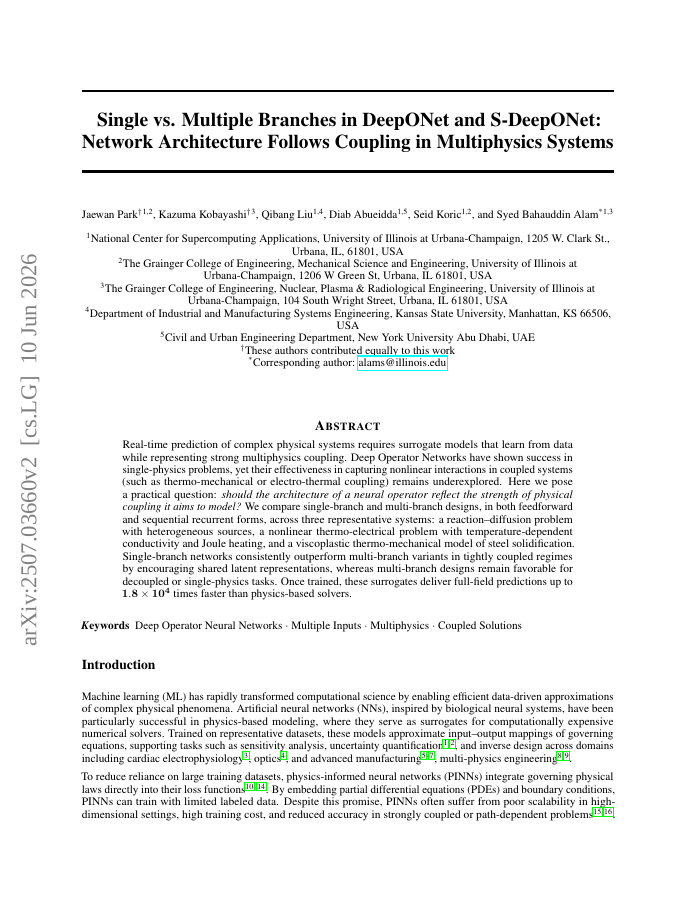
`Real-time prediction of complex physical systems requires surrogate models that learn from data while representing strong multiphysics coupling. Deep Operator Networks have shown success in single-physics problems, yet their effectiveness in capturing nonlinear interactions in coupled systems (such as thermo-mechanical or electro-thermal coupling) remains underexplored. Here we pose a practical question: should the architecture of a neural operator reflect the strength of physical coupling it aims to model? We compare single-branch and multi-branch designs, in both feedforward and sequential recurrent forms, across three representative systems: a reaction--diffusion problem with heterogeneous sources, a nonlinear thermo-electrical problem with temperature-dependent conductivity and Joule heating, and a viscoplastic thermo-mechanical model of steel solidification. Single-branch networks consistently outperform multi-branch variants in tightly coupled regimes by encouraging shared latent representations, whereas multi-branch designs remain favorable for decoupled or single-physics tasks. Once trained, these surrogates deliver full-field predictions up to 1.8 \times 10^4 times faster than physics-based solvers.
Single vs. Multiple Branches in DeepONet and S-DeepONet: Network Architecture Follows Coupling in Multiphysics Systems
`Real-time prediction of complex physical systems requires surrogate models that learn from data while representing strong multiphysics coupling. Deep Operator Networks have shown success in single-physics problems, yet their effectiveness in capturing nonlinear interactions in…
- Preview
- Year
- 2025
- Hosting
- Full text hostedCC-BY-4.0
Cite
Notes
Only stored in your browser.
Attribution
- Abstract & full text
- arxiv.org/abs/2507.03660CC-BY-4.0
- TL;DR
- Semantic Scholar