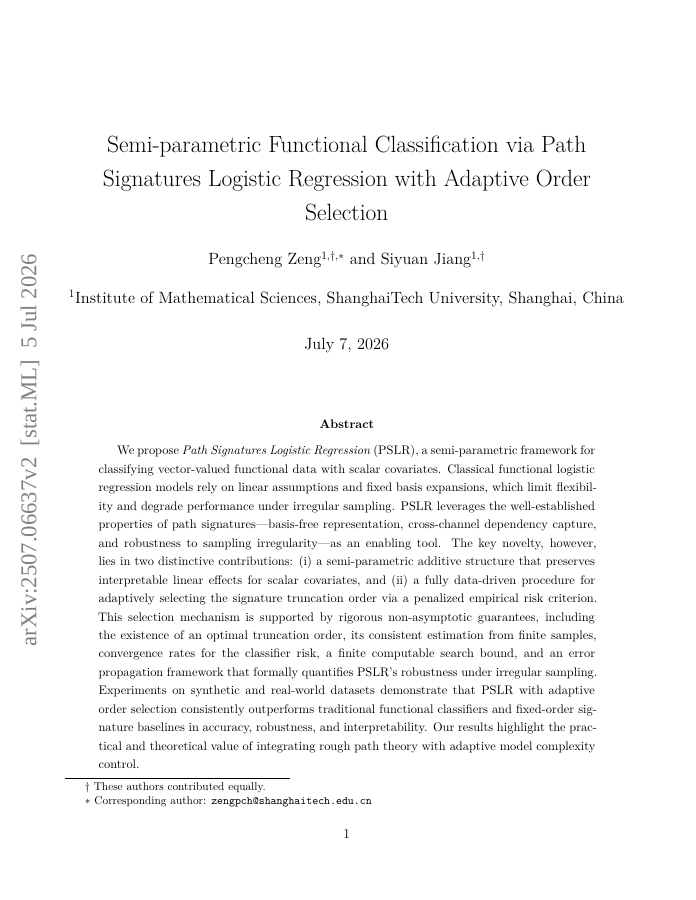
We propose Path Signatures Logistic Regression (PSLR), a semi-parametric framework for classifying vector-valued functional data with scalar covariates. Classical functional logistic regression models rely on linear assumptions and fixed basis expansions, which limit flexibility and degrade performance under irregular sampling. PSLR leverages the well-established properties of path signatures - basis-free representation, cross-channel dependency capture, and robustness to sampling irregularity - as an enabling tool. The key novelty, however, lies in two distinctive contributions: (i) a semi-parametric additive structure that preserves interpretable linear effects for scalar covariates, and (ii) a fully data-driven procedure for adaptively selecting the signature truncation order via a penalized empirical risk criterion. This selection mechanism is supported by rigorous non-asymptotic guarantees, including the existence of an optimal truncation order, its consistent estimation from finite samples, convergence rates for the classifier risk, a finite computable search bound, and an error propagation framework that formally quantifies PSLR's robustness under irregular sampling. Experiments on synthetic and real-world datasets demonstrate that PSLR with adaptive order selection consistently outperforms traditional functional classifiers and fixed-order signature baselines in accuracy, robustness, and interpretability. Our results highlight the practical and theoretical value of integrating rough path theory with adaptive model complexity control.
Semi-parametric Functional Classification via Path Signatures Logistic Regression with Adaptive Order Selection
We propose Path Signatures Logistic Regression (PSLR), a semi-parametric framework for classifying vector-valued functional data with scalar covariates. Classical functional logistic regression models rely on linear assumptions and fixed basis expansions, which limit flexibility…
- Preview
- Year
- 2025
- Hosting
- Full text hostedCC-BY-4.0
Cite
Notes
Only stored in your browser.
Attribution
- Abstract & full text
- arxiv.org/abs/2507.06637CC-BY-4.0
- TL;DR
- Semantic Scholar