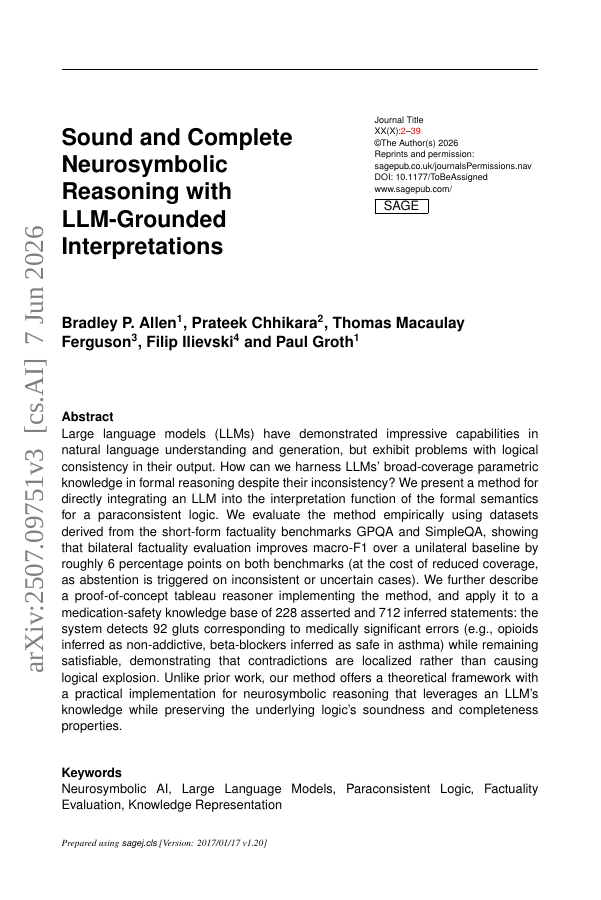
Large language models (LLMs) have demonstrated impressive capabilities in natural language understanding and generation, but exhibit problems with logical consistency in their output. How can we harness LLMs' broad-coverage parametric knowledge in formal reasoning despite their inconsistency? We present a method for directly integrating an LLM into the interpretation function of the formal semantics for a paraconsistent logic. We evaluate the method empirically using datasets derived from the short-form factuality benchmarks GPQA and SimpleQA, showing that bilateral factuality evaluation improves macro-F1 over a unilateral baseline by roughly 6 percentage points on both benchmarks (at the cost of reduced coverage, as abstention is triggered on inconsistent or uncertain cases). We further describe a proof-of-concept tableau reasoner implementing the method, and apply it to a medication-safety knowledge base of 228 asserted and 712 inferred statements: the system detects 92 gluts corresponding to medically significant errors (e.g., opioids inferred as non-addictive, beta-blockers inferred as safe in asthma) while remaining satisfiable, demonstrating that contradictions are localized rather than causing logical explosion. Unlike prior work, our method offers a theoretical framework with a practical implementation for neurosymbolic reasoning that leverages an LLM's knowledge while preserving the underlying logic's soundness and completeness properties.
Sound and Complete Neurosymbolic Reasoning with LLM-Grounded Interpretations
Large language models (LLMs) have demonstrated impressive capabilities in natural language understanding and generation, but exhibit problems with logical consistency in their output.
- Preview
- Year
- 2025
- Hosting
- Full text hostedCC-BY-4.0
Cite
Notes
Only stored in your browser.
Attribution
- Abstract & full text
- arxiv.org/abs/2507.09751CC-BY-4.0
- TL;DR
- Semantic Scholar