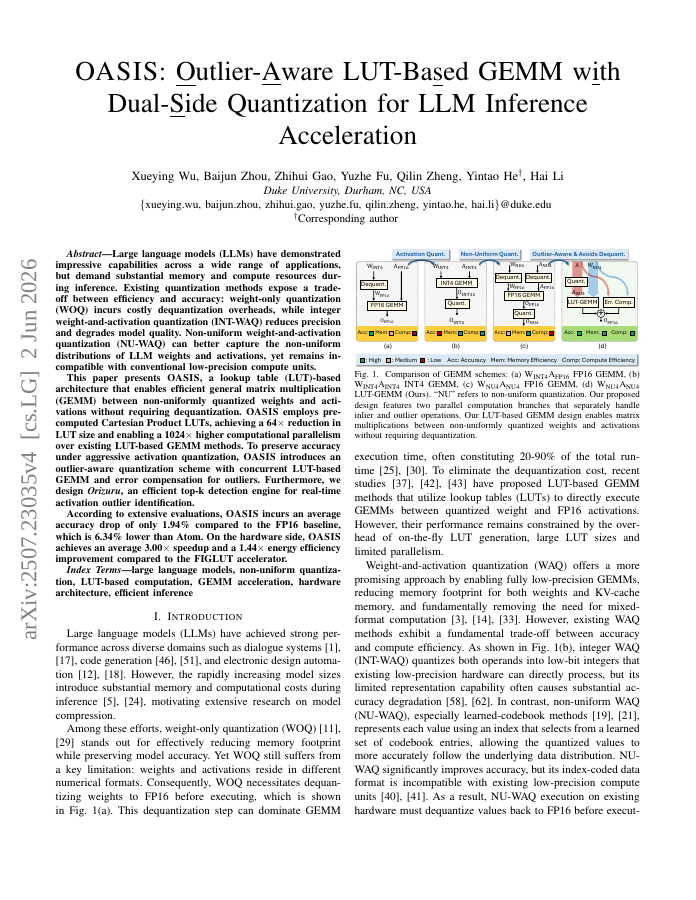
Large language models (LLMs) have demonstrated impressive capabilities across a wide range of applications, but demand substantial memory and compute resources during inference. Existing quantization methods expose a trade-off between efficiency and accuracy: weight-only quantization (WOQ) incurs costly dequantization overheads, while integer weight-and-activation quantization (INT-WAQ) reduces precision and degrades model quality. Non-uniform weight-and-activation quantization (NU-WAQ) can better capture the non-uniform distributions of LLM weights and activations, yet remains incompatible with conventional low-precision compute units. This paper presents OASIS, a lookup table (LUT)-based architecture that enables efficient general matrix multiplication (GEMM) between non-uniformly quantized weights and activations without requiring dequantization. OASIS employs pre-computed Cartesian Product LUTs, achieving a 64x reduction in LUT size and enabling a 1024x higher computational parallelism over existing LUT-based GEMM methods. To preserve accuracy under aggressive activation quantization, OASIS introduces an outlier-aware quantization scheme with concurrent LUT-based GEMM and error compensation for outliers. Furthermore, we design Orizuru, an efficient top-k detection engine for real-time activation outlier identification. According to extensive evaluations, OASIS incurs an average accuracy drop of only 1.98% compared to the FP16 baseline, which is 5.18% lower than Atom. On the hardware side, OASIS achieves an average 3.00x speedup and a 1.44x energy efficiency improvement compared to the FIGLUT accelerator.
OASIS: Outlier-Aware LUT-Based GEMM with Dual-Side Quantization for LLM Inference Acceleration
Large language models (LLMs) have demonstrated impressive capabilities across a wide range of applications, but demand substantial memory and compute resources during inference.
- Preview
- Year
- 2025
- Hosting
- Full text hostedCC-BY-4.0
Cite
Notes
Only stored in your browser.
Attribution
- Abstract & full text
- arxiv.org/abs/2507.23035CC-BY-4.0
- TL;DR
- Semantic Scholar