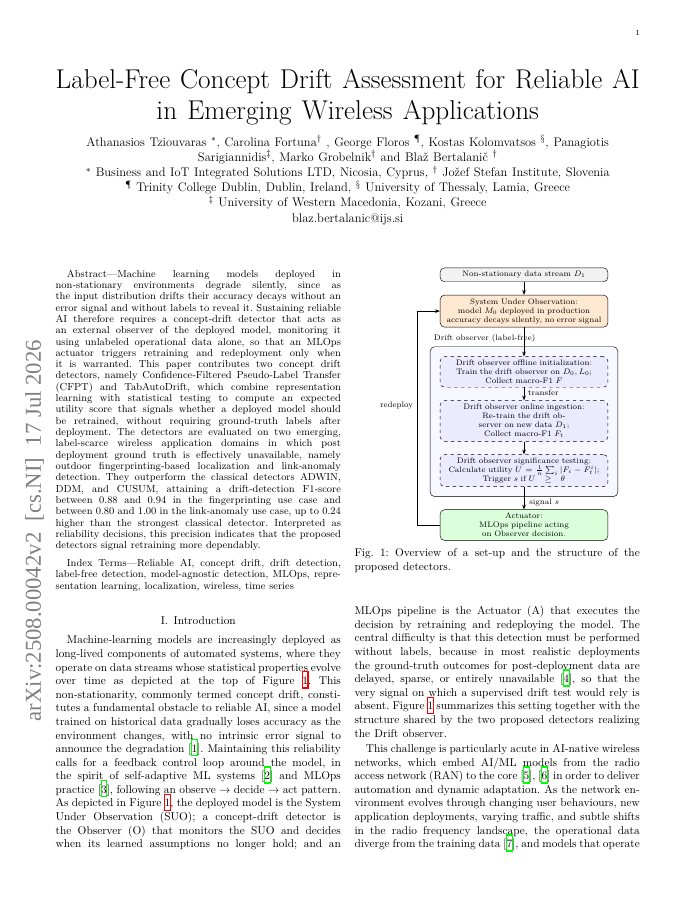
Machine learning models deployed in non-stationary environments degrade silently, since as the input distribution drifts their accuracy decays without an error signal and without labels to reveal it. Sustaining reliable AI therefore requires a concept-drift detector that acts as an external observer of the deployed model, monitoring it using unlabeled operational data alone, so that an MLOps actuator triggers retraining and redeployment only when it is warranted. This paper contributes two concept drift detectors, namely Confidence-Filtered Pseudo-Label Transfer (CFPT) and TabAutoDrift, which combine representation learning with statistical testing to compute an expected utility score that signals whether a deployed model should be retrained, without requiring ground-truth labels after deployment. The detectors are evaluated on two emerging, label-scarce wireless application domains in which post deployment ground truth is effectively unavailable, namely outdoor fingerprinting-based localization and link-anomaly detection. They outperform the classical detectors ADWIN, DDM, and CUSUM, attaining a drift-detection F1-score between 0.88 and 0.94 in the fingerprinting use case and between 0.80 and 1.00 in the link-anomaly use case, up to 0.24 higher than the strongest classical detector. Interpreted as reliability decisions, this precision indicates that the proposed detectors signal retraining more dependably.
Label-Free Concept Drift Assessment for Reliable AI in Emerging Wireless Applications
Machine learning models deployed in non-stationary environments degrade silently, since as the input distribution drifts their accuracy decays without an error signal and without labels to reveal it.
- Preview
- Year
- 2025
- Hosting
- Abstract onlyARXIV-DEFAULT
Cite
Notes
Only stored in your browser.
Attribution
- Abstract & full text
- arxiv.org/abs/2508.00042ARXIV-DEFAULT
- TL;DR
- Semantic Scholar