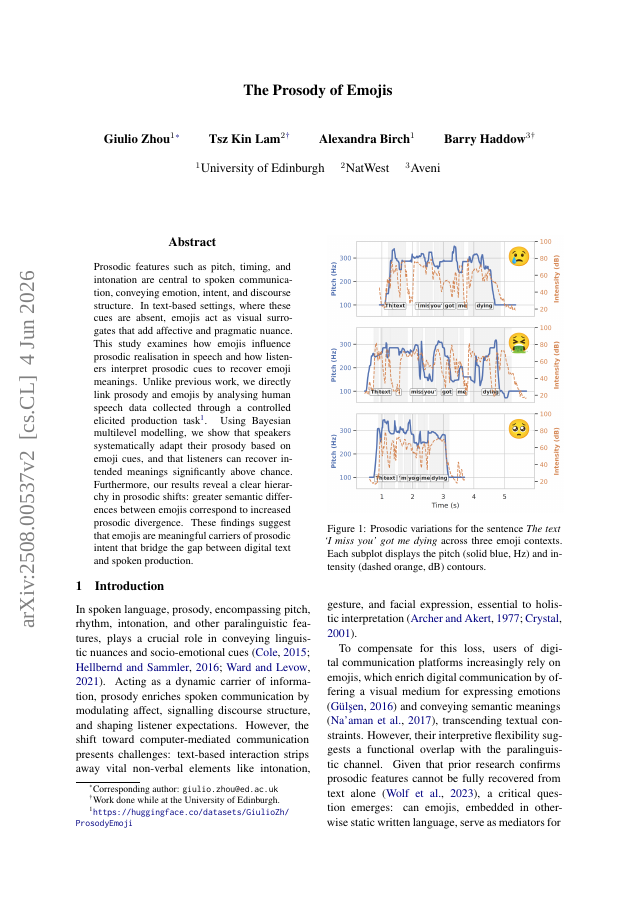
Prosodic features such as pitch, timing, and intonation are central to spoken communication, conveying emotion, intent, and discourse structure. In text-based settings, where these cues are absent, emojis act as visual surrogates that add affective and pragmatic nuance. This study examines how emojis influence prosodic realisation in speech and how listeners interpret prosodic cues to recover emoji meanings. Unlike previous work, we directly link prosody and emojis by analysing human speech data collected through a controlled elicited production task. Using Bayesian multilevel modelling, we show that speakers systematically adapt their prosody based on emoji cues, and that listeners can recover intended meanings significantly above chance. Furthermore, our results reveal a clear hierarchy in prosodic shifts: greater semantic differences between emojis correspond to increased prosodic divergence. These findings suggest that emojis are meaningful carriers of prosodic intent that bridge the gap between digital text and spoken production.
The Prosody of Emojis
Prosodic features such as pitch, timing, and intonation are central to spoken communication, conveying emotion, intent, and discourse structure. In text-based settings, where these cues are absent, emojis act as visual surrogates that add affective and pragmatic nuance.
- Preview
- Year
- 2025
- Hosting
- Excerpt onlyCC-BY-NC-SA-4.0
Cite
Notes
Only stored in your browser.
Attribution
- Abstract & full text
- arxiv.org/abs/2508.00537CC-BY-NC-SA-4.0
- TL;DR
- Semantic Scholar