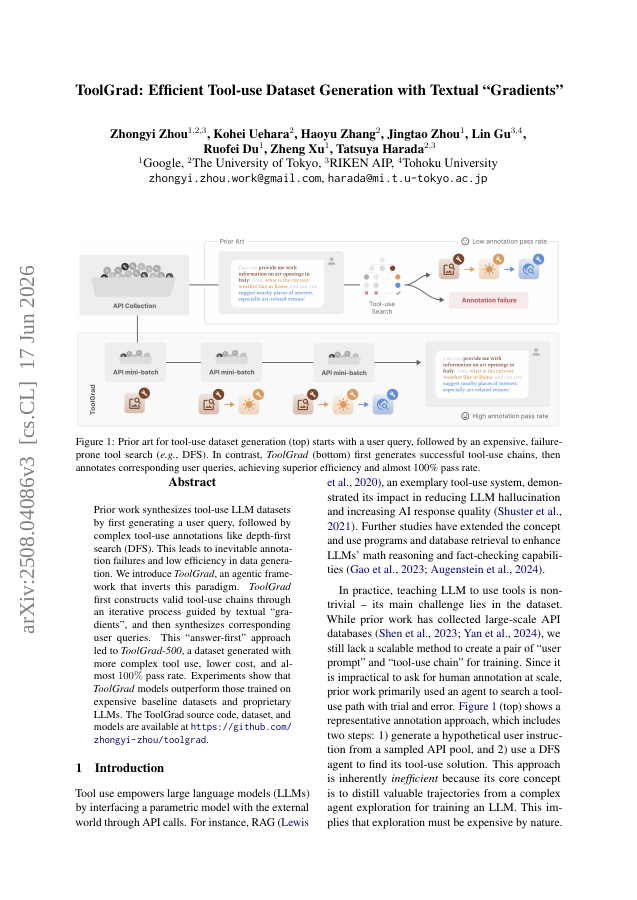
Prior work synthesizes tool-use LLM datasets by first generating a user query, followed by complex tool-use annotations like depth-first search (DFS). This leads to inevitable annotation failures and low efficiency in data generation. We introduce ToolGrad, an agentic framework that inverts this paradigm. ToolGrad first constructs valid tool-use chains through an iterative process guided by textual "gradients", and then synthesizes corresponding user queries. This "answer-first" approach led to ToolGrad-500, a dataset generated with more complex tool use, lower cost, and almost 100% pass rate. Experiments show that ToolGrad models outperform those trained on expensive baseline datasets and proprietary LLMs. The ToolGrad source code, dataset, and models are available at https://github.com/zhongyi-zhou/toolgrad.
ToolGrad: Efficient Tool-use Dataset Generation with Textual "Gradients"
Prior work synthesizes tool-use LLM datasets by first generating a user query, followed by complex tool-use annotations like depth-first search (DFS). This leads to inevitable annotation failures and low efficiency in data generation.
- Preview
- Year
- 2025
- Hosting
- Abstract onlyARXIV-DEFAULT
Cite
Notes
Only stored in your browser.
Attribution
- Abstract & full text
- arxiv.org/abs/2508.04086ARXIV-DEFAULT
- TL;DR
- Semantic Scholar