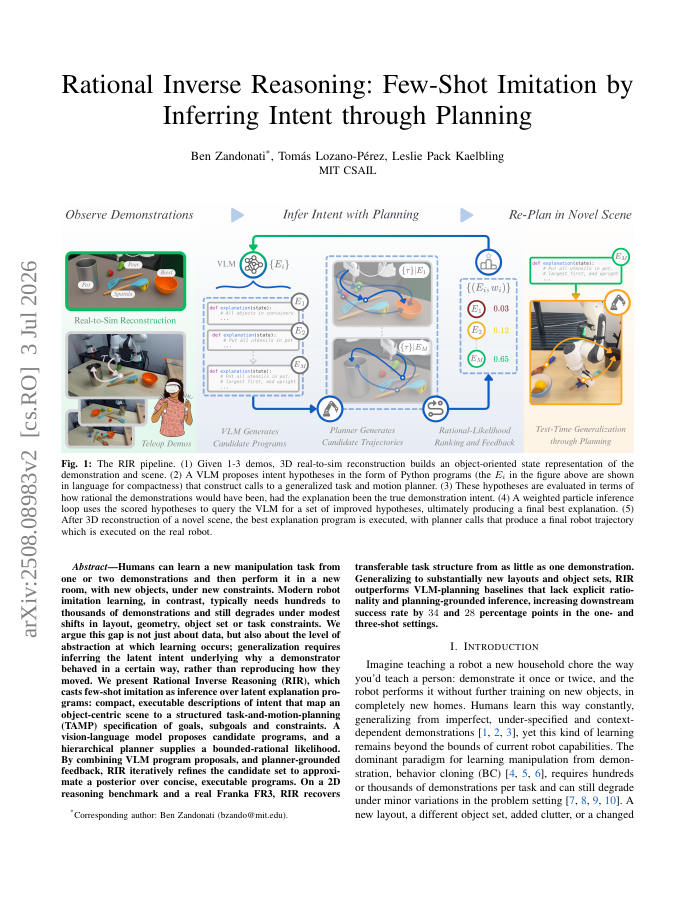
Humans can learn a new manipulation task from one or two demonstrations and then perform it in a new room, with new objects, under new constraints. Modern robot imitation learning, in contrast, typically needs hundreds to thousands of demonstrations and still degrades under modest shifts in layout, geometry, object set or task constraints. We argue this gap is not just about data, but also about the level of abstraction at which learning occurs; generalization requires inferring the latent intent underlying why a demonstrator behaved in a certain way, rather than reproducing how they moved. We present Rational Inverse Reasoning (RIR), which casts few-shot imitation as inference over latent explanation programs: compact, executable descriptions of intent that map an object-centric scene to a structured task-and-motion-planning (TAMP) specification of goals, subgoals and constraints. A vision-language model proposes candidate programs, and a hierarchical planner supplies a bounded-rational likelihood. By combining VLM program proposals, and planner-grounded feedback, RIR iteratively refines the candidate set to approximate a posterior over concise, executable programs. On a 2D reasoning benchmark and a real Franka FR3, RIR recovers transferable task structure from as little as one demonstration. Generalizing to substantially new layouts and object sets, RIR outperforms VLM-planning baselines that lack explicit rationality and planning-grounded inference, increasing downstream success rate by 34 and 28 percentage points in the one- and three-shot settings.
Rational Inverse Reasoning: Few-Shot Imitation by Inferring Intent through Planning
Humans can learn a new manipulation task from one or two demonstrations and then perform it in a new room, with new objects, under new constraints. Modern robot imitation learning, in contrast, typically needs hundreds to thousands of demonstrations and still degrades under…
- Preview
- Year
- 2025
- Hosting
- Abstract onlyARXIV-DEFAULT
Cite
Notes
Only stored in your browser.
Attribution
- Abstract & full text
- arxiv.org/abs/2508.08983ARXIV-DEFAULT
- TL;DR
- Semantic Scholar