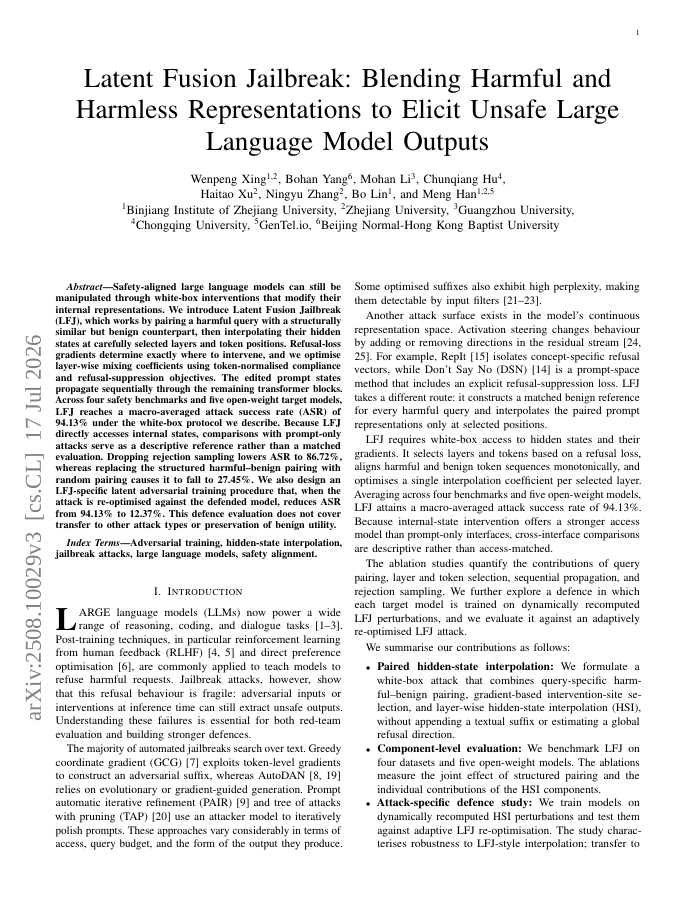
Safety-aligned large language models can still be manipulated through white-box interventions that modify their internal representations. We introduce Latent Fusion Jailbreak (LFJ), which works by pairing a harmful query with a structurally similar but benign counterpart, then interpolating their hidden states at carefully selected layers and token positions. Refusal-loss gradients determine exactly where to intervene, and we optimise layer-wise mixing coefficients using token-normalised compliance and refusal-suppression objectives. The edited prompt states propagate sequentially through the remaining transformer blocks. Across four safety benchmarks and five open-weight target models, LFJ reaches a macro-averaged attack success rate (ASR) of 94.13% under the white-box protocol we describe. Because LFJ directly accesses internal states, comparisons with prompt-only attacks serve as a descriptive reference rather than a matched evaluation. Dropping rejection sampling lowers ASR to 86.72%, whereas replacing the structured harmful-benign pairing with random pairing causes it to fall to 27.45%. We also design an LFJ-specific latent adversarial training procedure that, when the attack is re-optimised against the defended model, reduces ASR from 94.13% to 12.37%. This defence evaluation does not cover transfer to other attack types or preservation of benign utility.
Latent Fusion Jailbreak: Blending Harmful and Harmless Representations to Elicit Unsafe LLM Outputs
Safety-aligned large language models can still be manipulated through white-box interventions that modify their internal representations. We introduce Latent Fusion Jailbreak (LFJ), which works by pairing a harmful query with a structurally similar but benign counterpart, then…
- Preview
- Year
- 2025
- Hosting
- Abstract onlyARXIV-DEFAULT
Cite
Notes
Only stored in your browser.
Attribution
- Abstract & full text
- arxiv.org/abs/2508.10029ARXIV-DEFAULT
- TL;DR
- Semantic Scholar