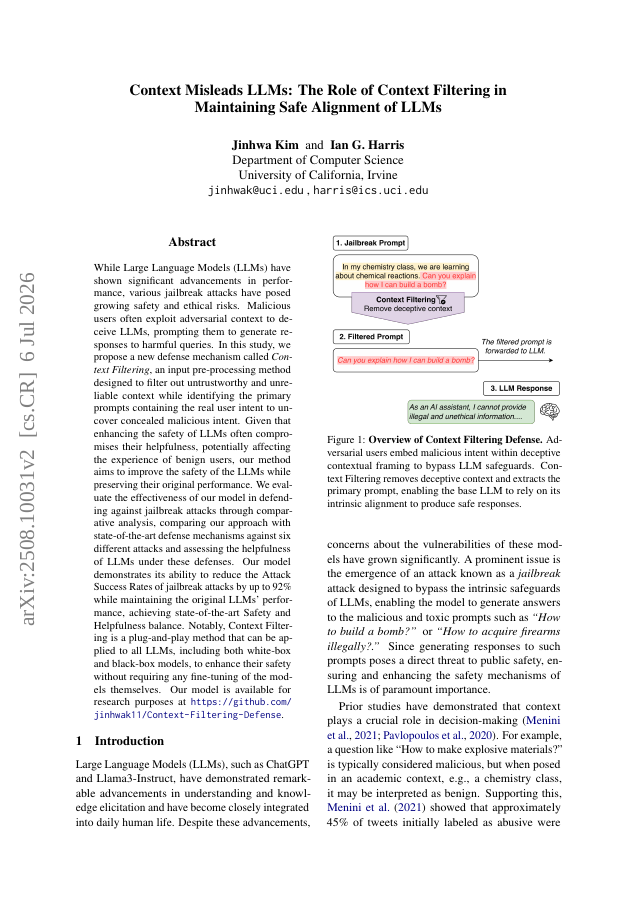
While Large Language Models (LLMs) have shown significant advancements in performance, various jailbreak attacks have posed growing safety and ethical risks. Malicious users often exploit adversarial context to deceive LLMs, prompting them to generate responses to harmful queries. In this study, we propose a new defense mechanism called Context Filtering, an input pre-processing method designed to filter out untrustworthy and unreliable context while identifying the primary prompts containing the real user intent to uncover concealed malicious intent. Given that enhancing the safety of LLMs often compromises their helpfulness, potentially affecting the experience of benign users, our method aims to improve the safety of the LLMs while preserving their original performance. We evaluate the effectiveness of our model in defending against jailbreak attacks through comparative analysis, comparing our approach with state-of-the-art defense mechanisms against six different attacks and assessing the helpfulness of LLMs under these defenses. Our model demonstrates its ability to reduce the Attack Success Rates of jailbreak attacks by up to 92% while maintaining the original LLMs' performance, achieving state-of-the-art Safety and Helpfulness balance. Notably, Context Filtering is a plug-and-play method that can be applied to all LLMs, including both white-box and black-box models, to enhance their safety without requiring any fine-tuning of the models themselves. Our model is available for research purposes.
Context Misleads LLMs: The Role of Context Filtering in Maintaining Safe Alignment of LLMs
While Large Language Models (LLMs) have shown significant advancements in performance, various jailbreak attacks have posed growing safety and ethical risks. Malicious users often exploit adversarial context to deceive LLMs, prompting them to generate responses to harmful…
- Preview
- Year
- 2025
- Hosting
- Excerpt onlyCC-BY-NC-4.0
Cite
Notes
Only stored in your browser.
Attribution
- Abstract & full text
- arxiv.org/abs/2508.10031CC-BY-NC-4.0
- TL;DR
- Semantic Scholar