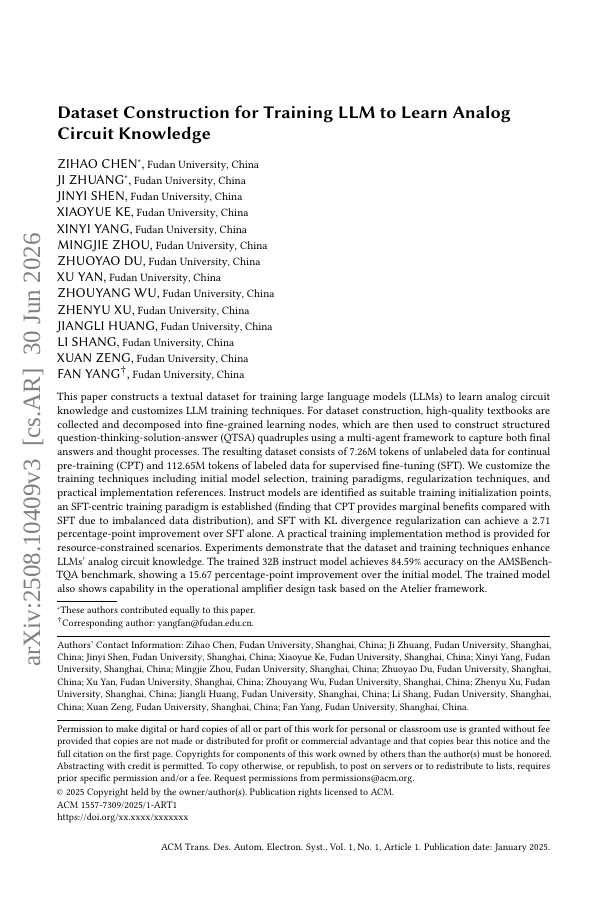
This paper constructs a textual dataset for training large language models (LLMs) to learn analog circuit knowledge and customizes LLM training techniques. For dataset construction, high-quality textbooks are collected and decomposed into fine-grained learning nodes, which are then used to construct structured question-thinking-solution-answer (QTSA) quadruples using a multi-agent framework to capture both final answers and thought processes. The resulting dataset consists of 7.26M tokens of unlabeled data for continual pre-training (CPT) and 112.65M tokens of labeled data for supervised fine-tuning (SFT). We customize the training techniques including initial model selection, training paradigms, regularization techniques, and practical implementation references. Instruct models are identified as suitable training initialization points, an SFT-centric training paradigm is established (finding that CPT provides marginal benefits compared with SFT due to imbalanced data distribution), and SFT with KL divergence regularization can achieve a 2.71 percentage-point improvement over SFT alone. A practical training implementation method is provided for resource-constrained scenarios. Experiments demonstrate that the dataset and training techniques enhance LLMs' analog circuit knowledge. The trained 32B instruct model achieves 84.59% accuracy on the AMSBench-TQA benchmark, showing a 15.67 percentage-point improvement over the initial model. The trained model also shows capability in the operational amplifier design task based on the Atelier framework.
Dataset Construction for Training LLM to Learn Analog Circuit Knowledge
This paper constructs a textual dataset for training large language models (LLMs) to learn analog circuit knowledge and customizes LLM training techniques. For dataset construction, high-quality textbooks are collected and decomposed into fine-grained learning nodes, which are…
- Preview
- Year
- 2025
- Hosting
- Abstract onlyARXIV-DEFAULT
Cite
Notes
Only stored in your browser.
Attribution
- Abstract & full text
- arxiv.org/abs/2508.10409ARXIV-DEFAULT
- TL;DR
- Semantic Scholar