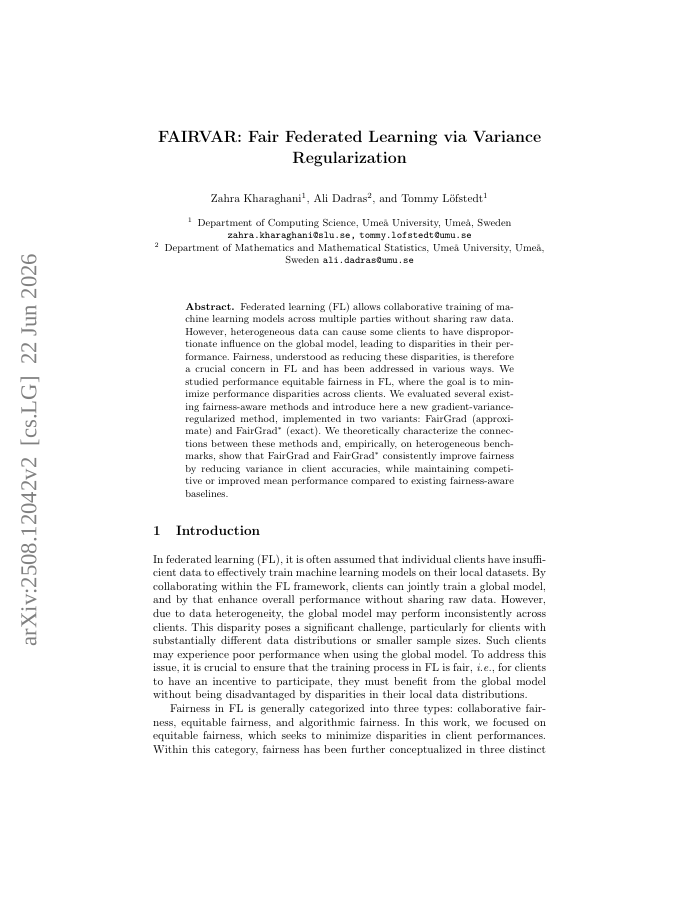
Federated learning (FL) allows collaborative training of machine learning models across multiple parties without sharing raw data. However, heterogeneous data can cause some clients to have disproportionate influence on the global model, leading to disparities in their performance. Fairness, understood as reducing these disparities, is therefore a crucial concern in FL and has been addressed in various ways. We studied performance equitable fairness in FL, where the goal is to minimize performance disparities across clients. We evaluated several existing fairness-aware methods and introduce here a new gradient-variance-regularized method, implemented in two variants: FairGrad (approximate) and FairGrad* (exact). We theoretically characterize the connections between these methods and, empirically, on heterogeneous benchmarks, show that FairGrad and FairGrad* consistently improve fairness by reducing variance in client accuracies, while maintaining competitive or improved mean performance compared to existing fairness-aware baselines.
FAIRVAR: Fair Federated Learning via Variance Regularization
Federated learning (FL) allows collaborative training of machine learning models across multiple parties without sharing raw data. However, heterogeneous data can cause some clients to have disproportionate influence on the global model, leading to disparities in their…
- Preview
- Year
- 2025
- Hosting
- Full text hostedCC-BY-4.0
Cite
Notes
Only stored in your browser.
Attribution
- Abstract & full text
- arxiv.org/abs/2508.12042CC-BY-4.0
- TL;DR
- Semantic Scholar