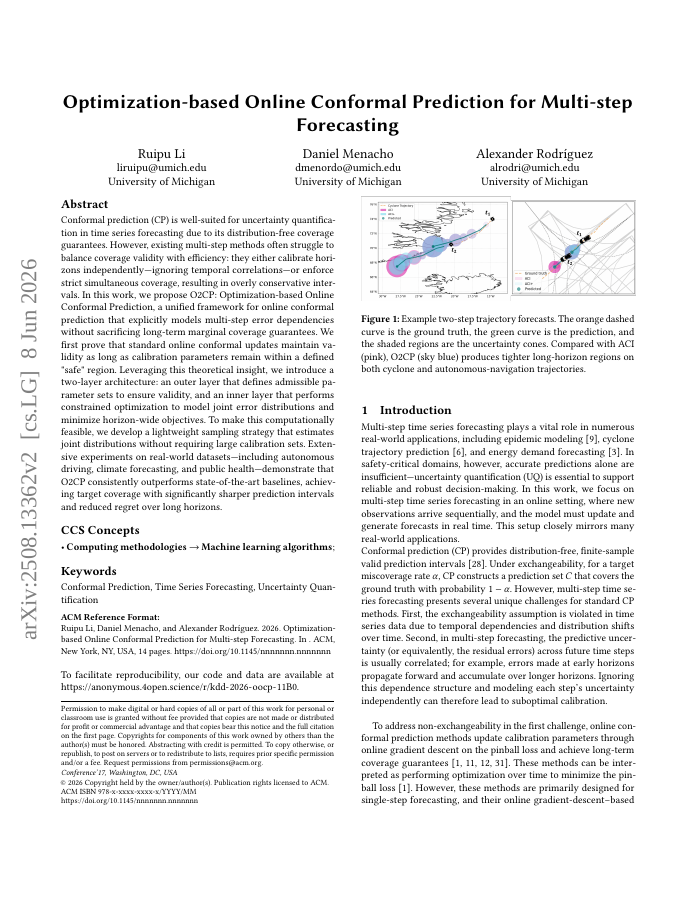
Conformal prediction (CP) is well-suited for uncertainty quantification in time series forecasting due to its distribution-free coverage guarantees. However, existing multi-step methods often struggle to balance coverage validity with efficiency: they either calibrate horizons independently, ignoring temporal correlations, or enforce strict simultaneous coverage, resulting in overly conservative intervals. In this work, we propose O2CP: Optimization-based Online Conformal Prediction, a unified framework for online conformal prediction that explicitly models multi-step error dependencies without sacrificing long-term marginal coverage guarantees. We first prove that standard online conformal updates maintain validity as long as calibration parameters remain within a defined "safe" region. Leveraging this theoretical insight, we introduce a two-layer architecture: an outer layer that defines admissible parameter sets to ensure validity, and an inner layer that performs constrained optimization to model joint error distributions and minimize horizon-wide objectives. To make this computationally feasible, we develop a lightweight sampling strategy that estimates joint distributions without requiring large calibration sets. Extensive experiments on real-world datasets, including autonomous driving, climate forecasting, and public health, demonstrate that O2CP consistently outperforms state-of-the-art baselines, achieving target coverage with significantly sharper prediction intervals and reduced regret over long horizons.
Optimization-based Online Conformal Prediction for Multi-step Forecasting
Conformal prediction (CP) is well-suited for uncertainty quantification in time series forecasting due to its distribution-free coverage guarantees. However, existing multi-step methods often struggle to balance coverage validity with efficiency: they either calibrate horizons…
- Preview
- Year
- 2025
- Hosting
- Abstract onlyARXIV-DEFAULT
Cite
Notes
Only stored in your browser.
Attribution
- Abstract & full text
- arxiv.org/abs/2508.13362ARXIV-DEFAULT
- TL;DR
- Semantic Scholar