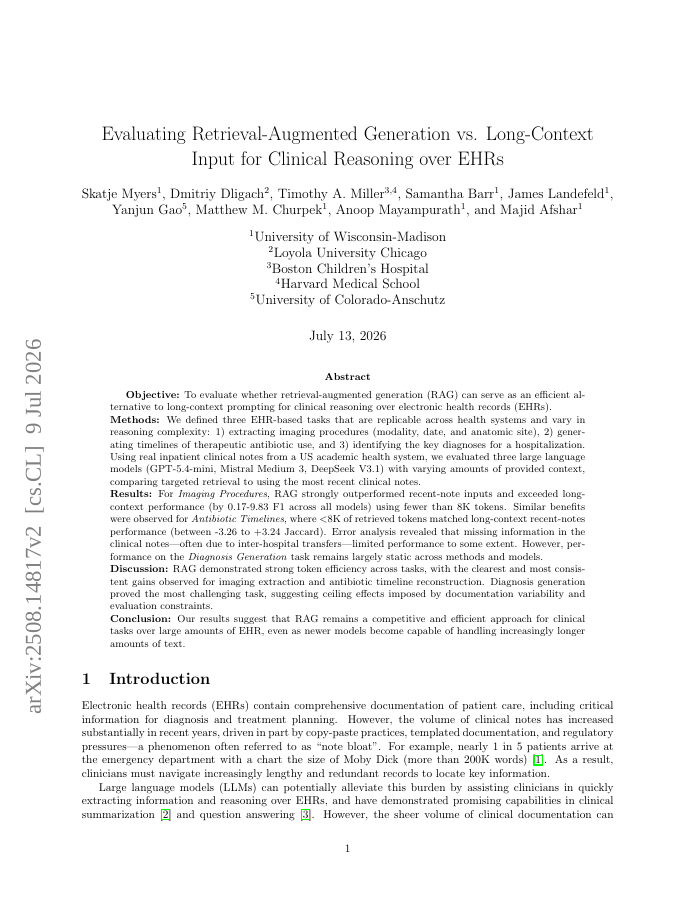
Objective: To evaluate whether retrieval-augmented generation (RAG) can serve as an efficient alternative to long-context prompting for clinical reasoning over electronic health records (EHRs). Methods: We defined three EHR-based tasks that are replicable across health systems and vary in reasoning complexity: 1) extracting imaging procedures (modality, date, and anatomic site), 2) generating timelines of therapeutic antibiotic use, and 3) identifying the key diagnoses for a hospitalization. Using real inpatient clinical notes from a US academic health system, we evaluated three large language models (GPT-5.4-mini, Mistral Medium 3, DeepSeek V3.1) with varying amounts of provided context, comparing targeted retrieval to using the most recent clinical notes. Results: For Imaging Procedures, RAG strongly outperformed recent-note inputs and exceeded long-context performance (by 0.17-9.83 F1 across all models) using fewer than 8K tokens. Similar benefits were observed for Antibiotic Timelines, where <8K of retrieved tokens matched long-context recent-notes performance (between -3.26 to +3.24 Jaccard). Error analysis revealed that missing information in the clinical notes--often due to inter-hospital transfers--limited performance to some extent. However, performance on the Diagnosis Generation task remains largely static across methods and models. Discussion: RAG demonstrated strong token efficiency across tasks, with the clearest and most consistent gains observed for imaging extraction and antibiotic timeline reconstruction. Diagnosis generation proved the most challenging task, suggesting ceiling effects imposed by documentation variability and evaluation constraints. Conclusion: Our results suggest that RAG remains a competitive and efficient approach for clinical tasks over large amounts of EHR, even as newer models become capable of handling increasingly longer amounts of text.
Evaluating Retrieval-Augmented Generation vs. Long-Context Input for Clinical Reasoning over EHRs
Objective: To evaluate whether retrieval-augmented generation (RAG) can serve as an efficient alternative to long-context prompting for clinical reasoning over electronic health records (EHRs).
- Preview
- Year
- 2025
- Hosting
- Excerpt onlyCC-BY-NC-SA-4.0
Cite
Notes
Only stored in your browser.
Attribution
- Abstract & full text
- arxiv.org/abs/2508.14817CC-BY-NC-SA-4.0
- TL;DR
- Semantic Scholar