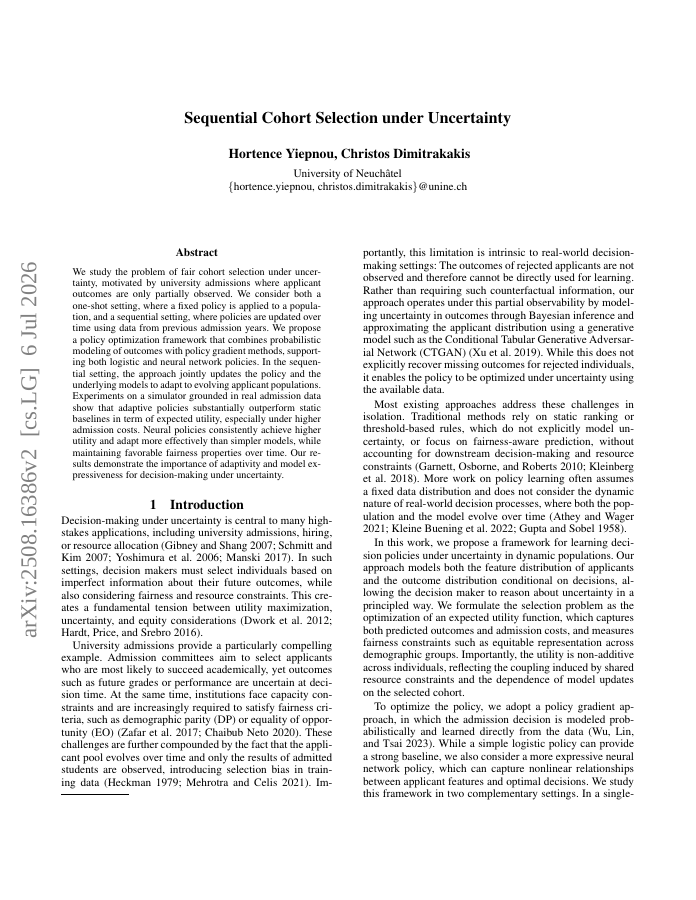
We study the problem of fair cohort selection under uncertainty, motivated by university admissions where applicant outcomes are only partially observed. We consider both a one-shot setting, where a fixed policy is applied to a population, and a sequential setting, where policies are updated over time using data from previous admission years. We propose a policy optimization framework that combines probabilistic modeling of outcomes with policy gradient methods, supporting both logistic and neural network policies. In the sequential setting, the approach jointly updates the policy and the underlying models to adapt to evolving applicant populations. Experiments on a simulator grounded in real admission data show that adaptive policies substantially outperform static baselines in term of expected utility, especially under higher admission costs. Neural policies consistently achieve higher utility and adapt more effectively than simpler models, while maintaining favorable fairness properties over time. Our results demonstrate the importance of adaptivity and model expressiveness for decision-making under uncertainty.
Sequential Cohort Selection under Uncertainty
We study the problem of fair cohort selection under uncertainty, motivated by university admissions where applicant outcomes are only partially observed. We consider both a one-shot setting, where a fixed policy is applied to a population, and a sequential setting, where…
- Preview
- Year
- 2025
- Hosting
- Full text hostedCC-BY-4.0
Cite
Notes
Only stored in your browser.
Attribution
- Abstract & full text
- arxiv.org/abs/2508.16386CC-BY-4.0
- TL;DR
- Semantic Scholar