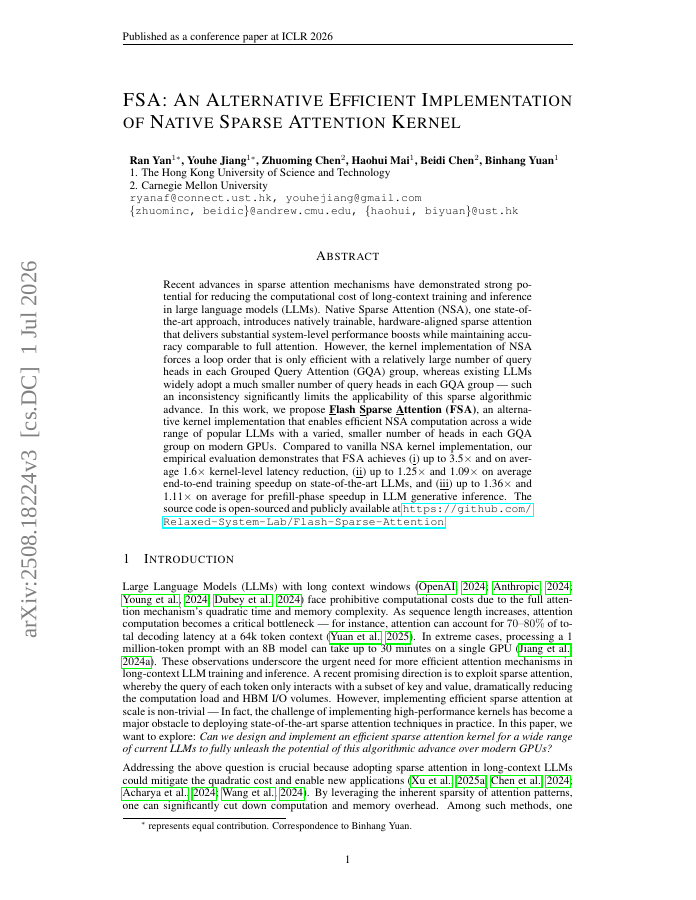
Recent advances in sparse attention mechanisms have demonstrated strong potential for reducing the computational cost of long-context training and inference in large language models (LLMs). Native Sparse Attention (NSA), one state-of-the-art approach, introduces natively trainable, hardware-aligned sparse attention that delivers substantial system-level performance boosts while maintaining accuracy comparable to full attention. However, the kernel implementation of NSA forces a loop order that is only efficient with a relatively large number of query heads in each Grouped Query Attention (GQA) group, whereas existing LLMs widely adopt a much smaller number of query heads in each GQA group -- such an inconsistency significantly limits the applicability of this sparse algorithmic advance. In this work, we propose Flash Sparse Attention (FSA), an alternative kernel implementation that enables efficient NSA computation across a wide range of popular LLMs with a varied, smaller number of heads in each GQA group on modern GPUs. Compared to vanilla NSA kernel implementation, our empirical evaluation demonstrates that FSA achieves (i) up to 3.5x and on average 1.6x kernel-level latency reduction, (ii) up to 1.25x and 1.09x on average end-to-end training speedup on state-of-the-art LLMs, and (iii) up to 1.36x and 1.11x on average for prefill-phase speedup in LLM generative inference. The source code is open-sourced and publicly available at https://github.com/Relaxed-System-Lab/Flash-Sparse-Attention.
FSA: An Alternative Efficient Implementation of Native Sparse Attention Kernel
Recent advances in sparse attention mechanisms have demonstrated strong potential for reducing the computational cost of long-context training and inference in large language models (LLMs).
- Preview
- Year
- 2025
- Hosting
- Abstract onlyARXIV-DEFAULT
Cite
Notes
Only stored in your browser.
Attribution
- Abstract & full text
- arxiv.org/abs/2508.18224ARXIV-DEFAULT
- TL;DR
- Semantic Scholar