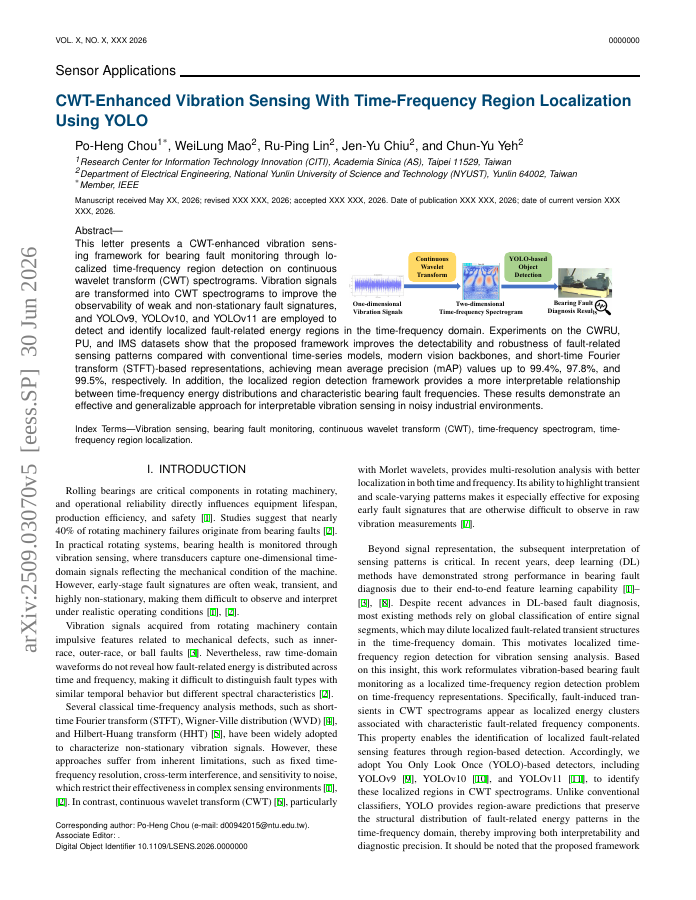
This letter presents a CWT-enhanced vibration sensing framework for bearing fault monitoring through localized time-frequency region detection on continuous wavelet transform (CWT) spectrograms. Vibration signals are transformed into CWT spectrograms to improve the observability of weak and non-stationary fault signatures, and YOLOv9, YOLOv10, and YOLOv11 are employed to detect and identify localized fault-related energy regions in the time-frequency domain. Experiments on the CWRU, PU, and IMS datasets show that the proposed framework improves the detectability and robustness of fault-related sensing patterns compared with conventional time-series models, modern vision backbones, and short-time Fourier transform (STFT)-based representations, achieving mean average precision (mAP) values up to 99.4%, 97.8%, and 99.5%, respectively. In addition, the localized region detection framework provides a more interpretable relationship between time-frequency energy distributions and characteristic bearing fault frequencies. These results demonstrate an effective and generalizable approach for interpretable vibration sensing in noisy industrial environments.
CWT-Enhanced Vibration Sensing With Time-Frequency Region Localization Using YOLO
This letter presents a CWT-enhanced vibration sensing framework for bearing fault monitoring through localized time-frequency region detection on continuous wavelet transform (CWT) spectrograms.
- Preview
- Year
- 2025
- Hosting
- Abstract onlyARXIV-DEFAULT
Cite
Notes
Only stored in your browser.
Attribution
- Abstract & full text
- arxiv.org/abs/2509.03070ARXIV-DEFAULT
- TL;DR
- Semantic Scholar