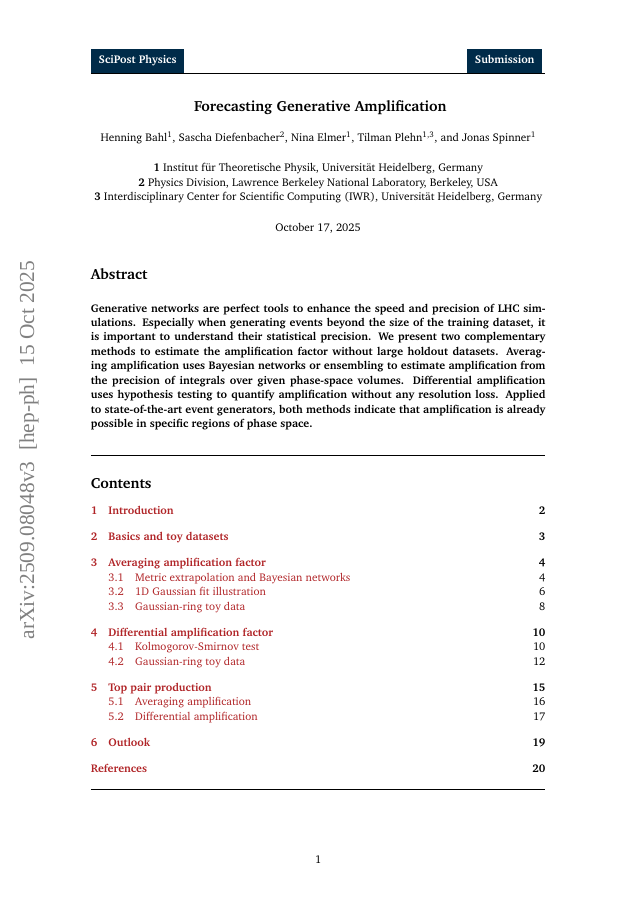
Generative networks are perfect tools to enhance the speed and precision of LHC simulations. It is important to understand their statistical precision, especially when generating events beyond the size of the training dataset. We present two complementary methods to estimate the amplification factor without large holdout datasets. Averaging amplification uses Bayesian networks or ensembling to estimate amplification from the precision of integrals over given phase-space volumes. Differential amplification uses hypothesis testing to quantify amplification without any resolution loss. Applied to state-of-the-art event generators, both methods indicate that amplification is possible in specific regions of phase space, but not yet across the entire distribution.
Forecasting Generative Amplification
Generative networks are perfect tools to enhance the speed and precision of LHC simulations. It is important to understand their statistical precision, especially when generating events beyond the size of the training dataset.
- Preview
- Year
- 2025
- Hosting
- Full text hostedCC-BY-4.0
Cite
Notes
Only stored in your browser.
Attribution
- Abstract & full text
- arxiv.org/abs/2509.08048CC-BY-4.0
- TL;DR
- Semantic Scholar