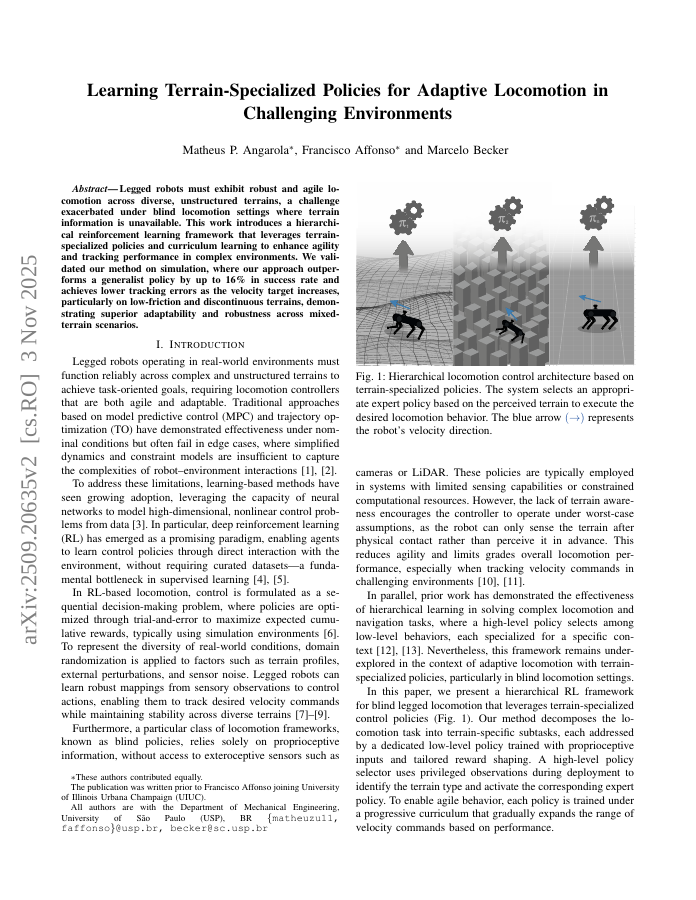
Legged robots must exhibit robust and agile locomotion across diverse, unstructured terrains, a challenge exacerbated under blind locomotion settings where terrain information is unavailable. This work introduces a hierarchical reinforcement learning framework that leverages terrain-specialized policies and curriculum learning to enhance agility and tracking performance in complex environments. We validated our method on simulation, where our approach outperforms a generalist policy by up to 16% in success rate and achieves lower tracking errors as the velocity target increases, particularly on low-friction and discontinuous terrains, demonstrating superior adaptability and robustness across mixed-terrain scenarios.
Learning Terrain-Specialized Policies for Adaptive Locomotion in Challenging Environments
Legged robots must exhibit robust and agile locomotion across diverse, unstructured terrains, a challenge exacerbated under blind locomotion settings where terrain information is unavailable.
- Preview
- Year
- 2025
- Hosting
- Abstract onlyARXIV-DEFAULT
Cite
Notes
Only stored in your browser.
Attribution
- Abstract & full text
- arxiv.org/abs/2509.20635ARXIV-DEFAULT
- TL;DR
- Semantic Scholar