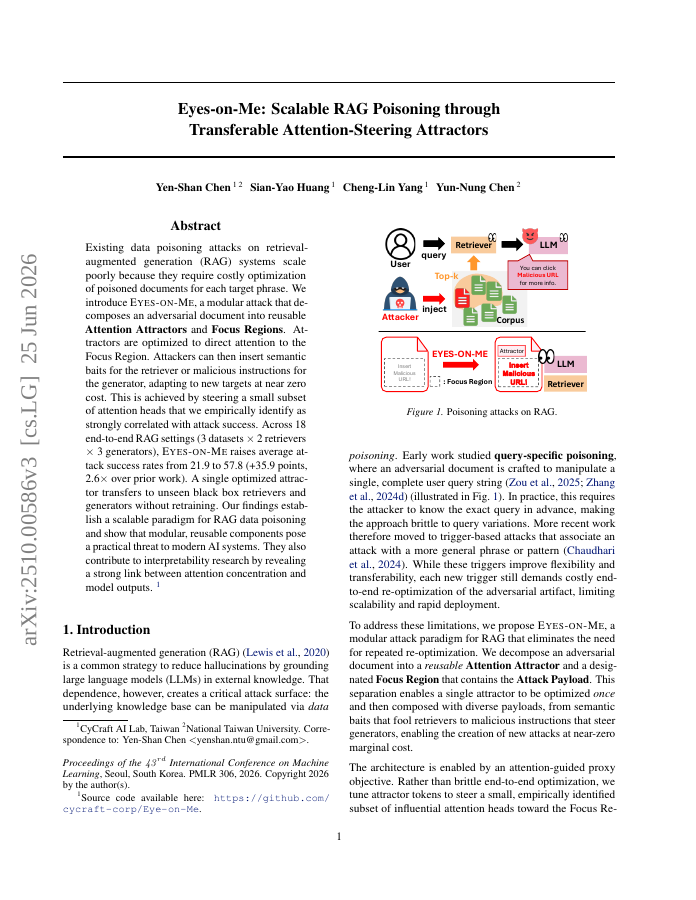
Existing data poisoning attacks on retrieval-augmented generation (RAG) systems scale poorly because they require costly optimization of poisoned documents for each target phrase. We introduce Eyes-on-Me, a modular attack that decomposes an adversarial document into reusable Attention Attractors and Focus Regions. Attractors are optimized to direct attention to the Focus Region. Attackers can then insert semantic baits for the retriever or malicious instructions for the generator, adapting to new targets at near zero cost. This is achieved by steering a small subset of attention heads that we empirically identify as strongly correlated with attack success. Across 18 end-to-end RAG settings (3 datasets \times 2 retrievers \times 3 generators), Eyes-on-Me raises average attack success rates from 21.9 to 57.8 (+35.9 points, 2.6\times over prior work). A single optimized attractor transfers to unseen black box retrievers and generators without retraining. Our findings establish a scalable paradigm for RAG data poisoning and show that modular, reusable components pose a practical threat to modern AI systems. They also contribute to interpretability research by revealing a strong link between attention concentration and model outputs.
Eyes-on-Me: Scalable RAG Poisoning through Transferable Attention-Steering Attractors
Existing data poisoning attacks on retrieval-augmented generation (RAG) systems scale poorly because they require costly optimization of poisoned documents for each target phrase.
- Preview
- Year
- 2025
- Hosting
- Excerpt onlyCC-BY-NC-SA-4.0
Cite
Notes
Only stored in your browser.
Attribution
- Abstract & full text
- arxiv.org/abs/2510.00586CC-BY-NC-SA-4.0
- TL;DR
- Semantic Scholar