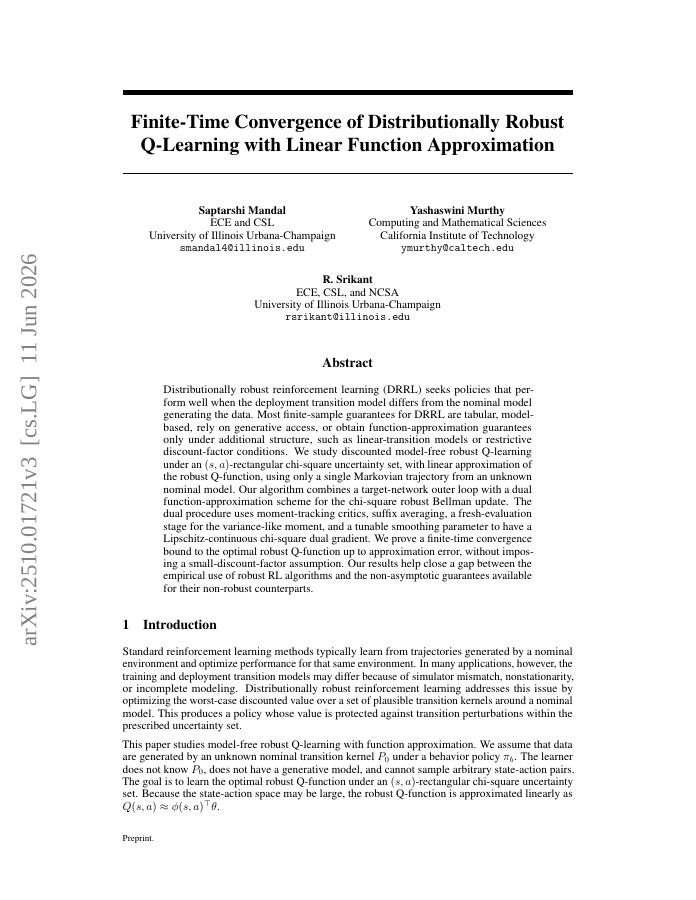
Distributionally robust reinforcement learning (DRRL) seeks policies that perform well when the deployment transition model differs from the nominal model generating the data. Most finite-sample guarantees for DRRL are tabular, model-based, rely on generative access, or obtain function-approximation guarantees only under additional structure, such as linear-transition models or restrictive discount-factor conditions. We study discounted model-free robust Q-learning under an (s,a)-rectangular chi-square uncertainty set, with linear approximation of the robust Q-function, using only a single Markovian trajectory from an unknown nominal model. Our algorithm combines a target-network outer loop with a dual function-approximation scheme for the chi-square robust Bellman update. The dual procedure uses moment-tracking critics, suffix averaging, a fresh-evaluation stage for the variance-like moment, and a tunable smoothing parameter to have a Lipschitz-continuous chi-square dual gradient. We prove a finite-time convergence bound to the optimal robust Q-function up to approximation error, without imposing a small-discount-factor assumption. Our results help close a gap between the empirical use of robust RL algorithms and the non-asymptotic guarantees available for their non-robust counterparts.
Finite-Time Convergence of Distributionally Robust Q-Learning with Linear Function Approximation
Distributionally robust reinforcement learning (DRRL) seeks policies that perform well when the deployment transition model differs from the nominal model generating the data.
- Preview
- Year
- 2025
- Hosting
- Full text hostedCC-BY-4.0
Cite
Notes
Only stored in your browser.
Attribution
- Abstract & full text
- arxiv.org/abs/2510.01721CC-BY-4.0
- TL;DR
- Semantic Scholar