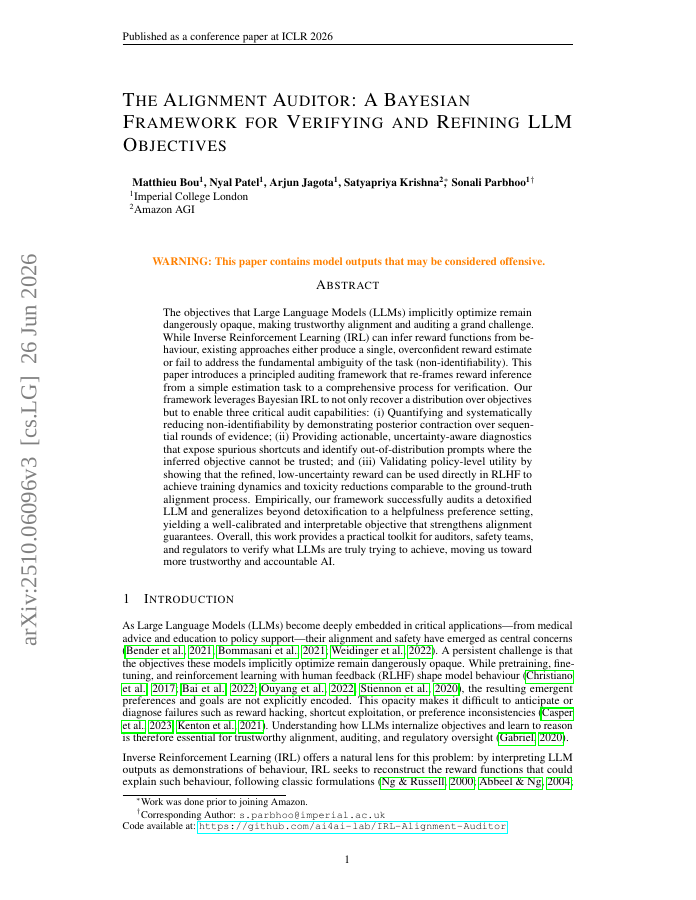
The objectives that Large Language Models (LLMs) implicitly optimize remain dangerously opaque, making trustworthy alignment and auditing a grand challenge. While Inverse Reinforcement Learning (IRL) can infer reward functions from behaviour, existing approaches either produce a single, overconfident reward estimate or fail to address the fundamental ambiguity of the task (non-identifiability). This paper introduces a principled auditing framework that re-frames reward inference from a simple estimation task to a comprehensive process for verification. Our framework leverages Bayesian IRL to not only recover a distribution over objectives but to enable three critical audit capabilities: (i) Quantifying and systematically reducing non-identifiability by demonstrating posterior contraction over sequential rounds of evidence; (ii) Providing actionable, uncertainty-aware diagnostics that expose spurious shortcuts and identify out-of-distribution prompts where the inferred objective cannot be trusted; and (iii) Validating policy-level utility by showing that the refined, low-uncertainty reward can be used directly in RLHF to achieve training dynamics and toxicity reductions comparable to the ground-truth alignment process. Empirically, our framework successfully audits a detoxified LLM, yielding a well-calibrated and interpretable objective that strengthens alignment guarantees. Overall, this work provides a practical toolkit for auditors, safety teams, and regulators to verify what LLMs are truly trying to achieve, moving us toward more trustworthy and accountable AI.
The Alignment Auditor: A Bayesian Framework for Verifying and Refining LLM Objectives
The objectives that Large Language Models (LLMs) implicitly optimize remain dangerously opaque, making trustworthy alignment and auditing a grand challenge. While Inverse Reinforcement Learning (IRL) can infer reward functions from behaviour, existing approaches either produce a…
- Preview
- Year
- 2025
- Hosting
- Full text hostedCC-BY-4.0
Cite
Notes
Only stored in your browser.
Attribution
- Abstract & full text
- arxiv.org/abs/2510.06096CC-BY-4.0
- TL;DR
- Semantic Scholar