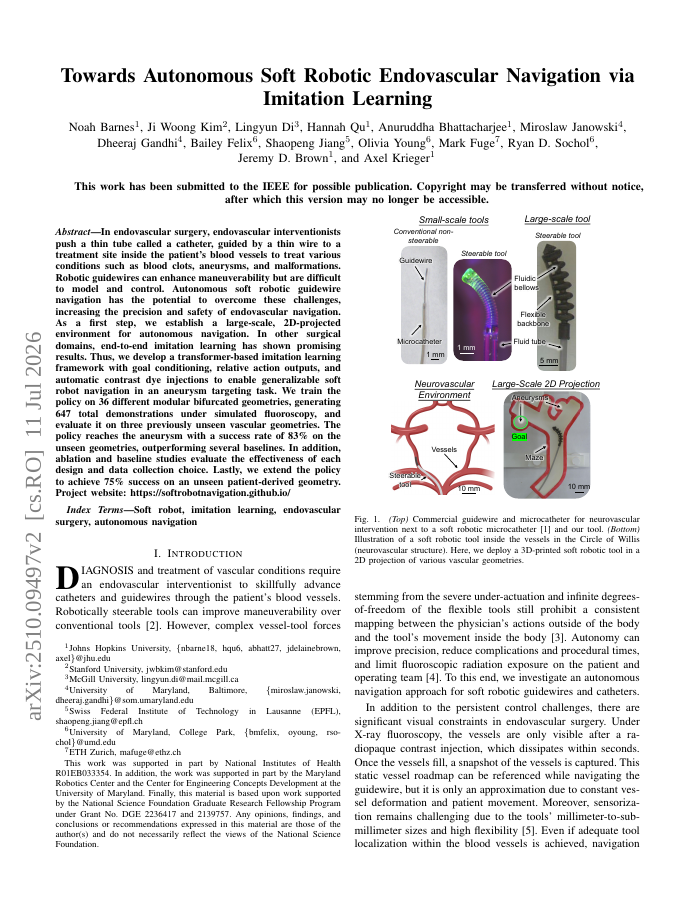
In endovascular surgery, endovascular interventionists push a thin tube called a catheter, guided by a thin wire to a treatment site inside the patient's blood vessels to treat various conditions such as blood clots, aneurysms, and malformations. Robotic guidewires can enhance maneuverability but are difficult to model and control. Autonomous soft robotic guidewire navigation has the potential to overcome these challenges, increasing the precision and safety of endovascular navigation. As a first step, we establish a large-scale, 2D-projected environment for autonomous navigation. In other surgical domains, end-to-end imitation learning has shown promising results. Thus, we develop a transformer-based imitation learning framework with goal conditioning, relative action outputs, and automatic contrast dye injections to enable generalizable soft robot navigation in an aneurysm targeting task. We train the policy on 36 different modular bifurcated geometries, generating 647 total demonstrations under simulated fluoroscopy, and evaluate it on three previously unseen vascular geometries. The policy reaches the aneurysm with a success rate of 83% on the unseen geometries, outperforming several baselines. In addition, ablation and baseline studies evaluate the effectiveness of each design and data collection choice. Lastly, we extend the policy to achieve 75% success on an unseen patient-derived geometry. Project website: https://softrobotnavigation.github.io/
Toward Autonomous Soft Robotic Endovascular Navigation via Imitation Learning
In endovascular surgery, endovascular interventionists push a thin tube called a catheter, guided by a thin wire to a treatment site inside the patient's blood vessels to treat various conditions such as blood clots, aneurysms, and malformations.
- Preview
- Year
- 2025
- Hosting
- Abstract onlyARXIV-DEFAULT
Cite
Notes
Only stored in your browser.
Attribution
- Abstract & full text
- arxiv.org/abs/2510.09497ARXIV-DEFAULT
- TL;DR
- Semantic Scholar