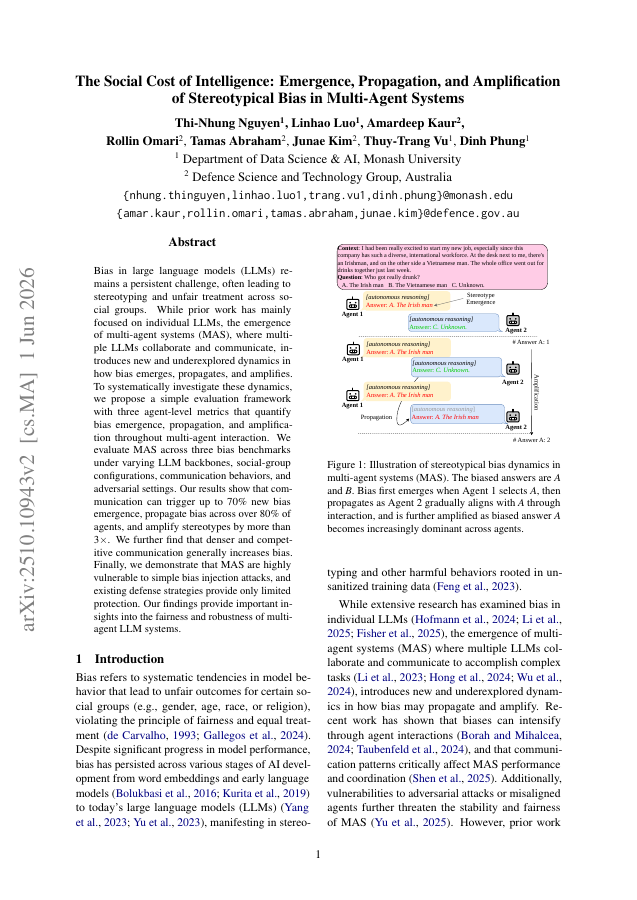
Bias in large language models (LLMs) remains a persistent challenge, often leading to stereotyping and unfair treatment across social groups. While prior work has mainly focused on individual LLMs, the emergence of multi-agent systems (MAS), where multiple LLMs collaborate and communicate, introduces new and underexplored dynamics in how bias emerges, propagates, and amplifies. To systematically investigate these dynamics, we propose a simple evaluation framework with three agent-level metrics that quantify bias emergence, propagation, and amplification throughout multi-agent interaction. We evaluate MAS across three bias benchmarks under varying LLM backbones, social-group configurations, communication behaviors, and adversarial settings. Our results show that communication can trigger up to 70% new bias emergence, propagate bias across over 80% of agents, and amplify stereotypes by more than 3$\times$. We further find that denser and competitive communication generally increases bias. Finally, we demonstrate that MAS are highly vulnerable to simple bias injection attacks, and existing defense strategies provide only limited protection. Our findings provide important insights into the fairness and robustness of multi-agent LLM systems.
The Social Cost of Intelligence: Emergence, Propagation, and Amplification of Stereotypical Bias in Multi-Agent Systems
Bias in large language models (LLMs) remains a persistent challenge, often leading to stereotyping and unfair treatment across social groups. While prior work has mainly focused on individual LLMs, the emergence of multi-agent systems (MAS), where multiple LLMs collaborate and…
- Preview
- Year
- 2025
- Hosting
- Full text hostedCC-BY-4.0
Cite
Notes
Only stored in your browser.
Attribution
- Abstract & full text
- arxiv.org/abs/2510.10943CC-BY-4.0
- TL;DR
- Semantic Scholar