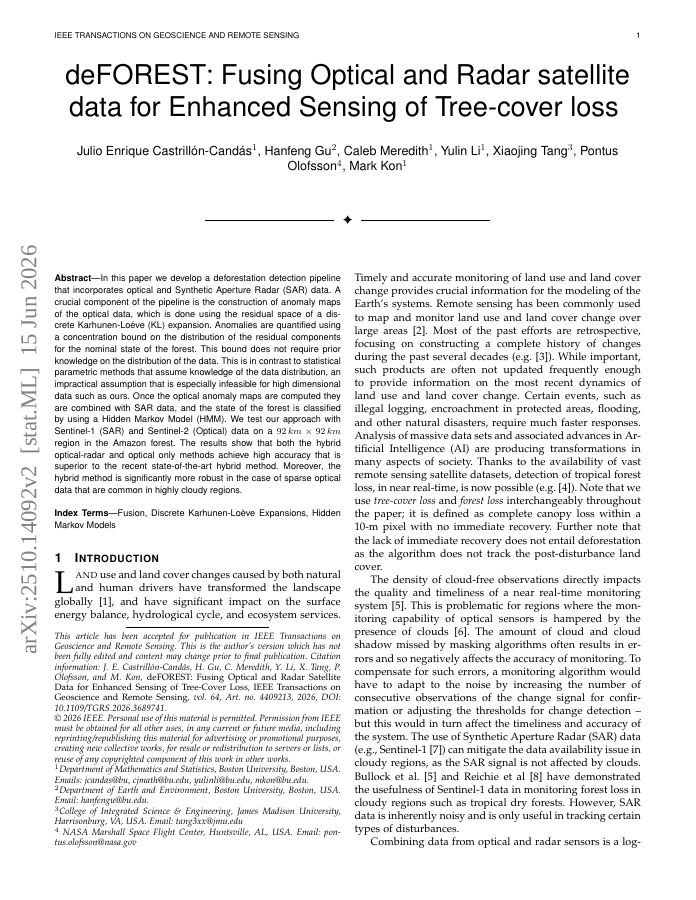
In this paper we develop a deforestation detection pipeline that incorporates optical and Synthetic Aperture Radar (SAR) data. A crucial component of the pipeline is the construction of anomaly maps of the optical data, which is done using the residual space of a discrete Karhunen-Loéve (KL) expansion. Anomalies are quantified using a concentration bound on the distribution of the residual components for the nominal state of the forest. This bound does not require prior knowledge on the distribution of the data. This is in contrast to statistical parametric methods that assume knowledge of the data distribution, an impractical assumption that is especially infeasible for high dimensional data such as ours. Once the optical anomaly maps are computed they are combined with SAR data, and the state of the forest is classified by using a Hidden Markov Model (HMM). We test our approach with Sentinel-1 (SAR) and Sentinel-2 (Optical) data on a 92,km \times 92,km region in the Amazon forest. The results show that both the hybrid optical-radar and optical only methods achieve high accuracy that is superior to the recent state-of-the-art hybrid method. Moreover, the hybrid method is significantly more robust in the case of sparse optical data that are common in highly cloudy regions.
deFOREST: Fusing Optical and Radar satellite data for Enhanced Sensing of Tree-loss
In this paper we develop a deforestation detection pipeline that incorporates optical and Synthetic Aperture Radar (SAR) data. A crucial component of the pipeline is the construction of anomaly maps of the optical data, which is done using the residual space of a discrete…
- Preview
- Year
- 2025
- Hosting
- Abstract onlyARXIV-DEFAULT
Cite
Notes
Only stored in your browser.
Attribution
- Abstract & full text
- arxiv.org/abs/2510.14092ARXIV-DEFAULT
- TL;DR
- Semantic Scholar