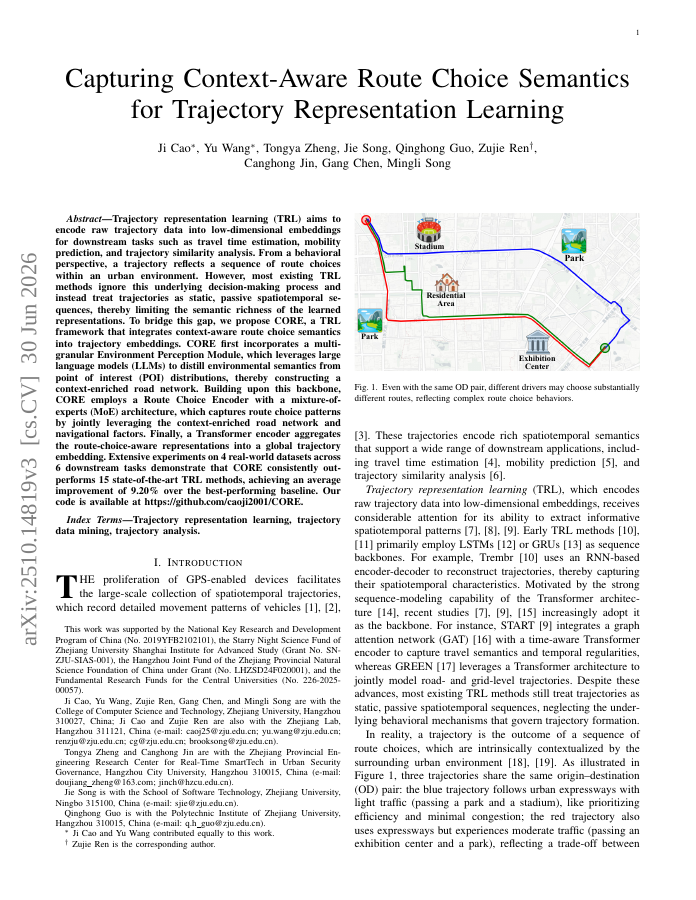
Trajectory representation learning (TRL) aims to encode raw trajectory data into low-dimensional embeddings for downstream tasks such as travel time estimation, mobility prediction, and trajectory similarity analysis. From a behavioral perspective, a trajectory reflects a sequence of route choices within an urban environment. However, most existing TRL methods ignore this underlying decision-making process and instead treat trajectories as static, passive spatiotemporal sequences, thereby limiting the semantic richness of the learned representations. To bridge this gap, we propose CORE, a TRL framework that integrates context-aware route choice semantics into trajectory embeddings. CORE first incorporates a multi-granular Environment Perception Module, which leverages large language models (LLMs) to distill environmental semantics from point of interest (POI) distributions, thereby constructing a context-enriched road network. Building upon this backbone, CORE employs a Route Choice Encoder with a mixture-of-experts (MoE) architecture, which captures route choice patterns by jointly leveraging the context-enriched road network and navigational factors. Finally, a Transformer encoder aggregates the route-choice-aware representations into a global trajectory embedding. Extensive experiments on 4 real-world datasets across 6 downstream tasks demonstrate that CORE consistently outperforms 15 state-of-the-art TRL methods, achieving an average improvement of 9.20% over the best-performing baseline. Our code is available at https://github.com/caoji2001/CORE.
Capturing Context-Aware Route Choice Semantics for Trajectory Representation Learning
Trajectory representation learning (TRL) aims to encode raw trajectory data into low-dimensional embeddings for downstream tasks such as travel time estimation, mobility prediction, and trajectory similarity analysis.
- Preview
- Year
- 2025
- Hosting
- Abstract onlyARXIV-DEFAULT
Cite
Notes
Only stored in your browser.
Attribution
- Abstract & full text
- arxiv.org/abs/2510.14819ARXIV-DEFAULT
- TL;DR
- Semantic Scholar