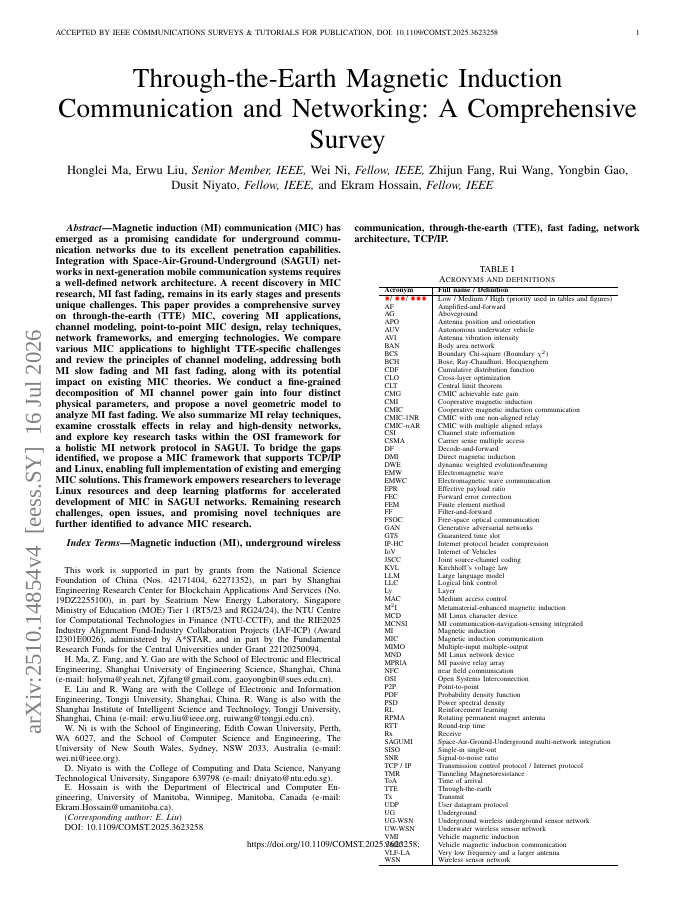
Magnetic induction (MI) communication (MIC) has emerged as a promising candidate for underground communication networks due to its excellent penetration capabilities. Integration with Space-Air-Ground-Underground (SAGUI) networks in next-generation mobile communication systems requires a well-defined network architecture. A recent discovery in MIC research, MI fast fading, remains in its early stages and presents unique challenges. This paper provides a comprehensive survey on through-the-earth (TTE) MIC, covering MI applications, channel modeling, point-to-point MIC design, relay techniques, network frameworks, and emerging technologies. We compare various MIC applications to highlight TTE-specific challenges and review the principles of channel modeling, addressing both MI slow fading and MI fast fading, along with its potential impact on existing MIC theories. We conduct a fine-grained decomposition of MI channel power gain into four distinct physical parameters, and propose a novel geometric model to analyze MI fast fading. We also summarize MI relay techniques, examine crosstalk effects in relay and high-density networks, and explore key research tasks within the OSI framework for a holistic MI network protocol in SAGUI. To bridge the gaps identified, we propose a MIC framework that supports TCP/IP and Linux, enabling full implementation of existing and emerging MIC solutions. This framework empowers researchers to leverage Linux resources and deep learning platforms for accelerated development of MIC in SAGUI networks. Remaining research challenges, open issues, and promising novel techniques are further identified to advance MIC research.
Through-the-Earth Magnetic Induction Communication and Networking: A Comprehensive Survey
Magnetic induction (MI) communication (MIC) has emerged as a promising candidate for underground communication networks due to its excellent penetration capabilities. Integration with Space-Air-Ground-Underground (SAGUI) networks in next-generation mobile communication systems…
- Preview
- Year
- 2025
- Hosting
- Abstract onlyARXIV-DEFAULT
Cite
Notes
Only stored in your browser.
Attribution
- Abstract & full text
- arxiv.org/abs/2510.14854ARXIV-DEFAULT
- TL;DR
- Semantic Scholar