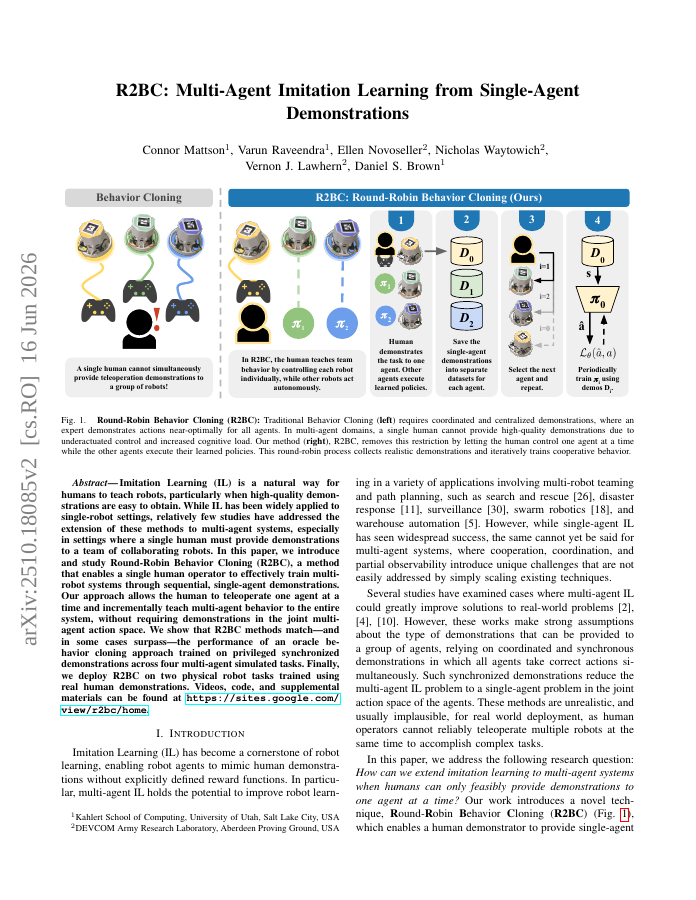
Imitation Learning (IL) is a natural way for humans to teach robots, particularly when high-quality demonstrations are easy to obtain. While IL has been widely applied to single-robot settings, relatively few studies have addressed the extension of these methods to multi-agent systems, especially in settings where a single human must provide demonstrations to a team of collaborating robots. In this paper, we introduce and study Round-Robin Behavior Cloning (R2BC), a method that enables a single human operator to effectively train multi-robot systems through sequential, single-agent demonstrations. Our approach allows the human to teleoperate one agent at a time and incrementally teach multi-agent behavior to the entire system, without requiring demonstrations in the joint multi-agent action space. We show that R2BC methods match, and in some cases surpass, the performance of an oracle behavior cloning approach trained on privileged synchronized demonstrations across four multi-agent simulated tasks. Finally, we deploy R2BC on two physical robot tasks trained using real human demonstrations.
R2BC: Multi-Agent Imitation Learning from Single-Agent Demonstrations
Imitation Learning (IL) is a natural way for humans to teach robots, particularly when high-quality demonstrations are easy to obtain. While IL has been widely applied to single-robot settings, relatively few studies have addressed the extension of these methods to multi-agent…
- Preview
- Year
- 2025
- Hosting
- Full text hostedCC-BY-4.0
Cite
Notes
Only stored in your browser.
Attribution
- Abstract & full text
- arxiv.org/abs/2510.18085CC-BY-4.0
- TL;DR
- Semantic Scholar