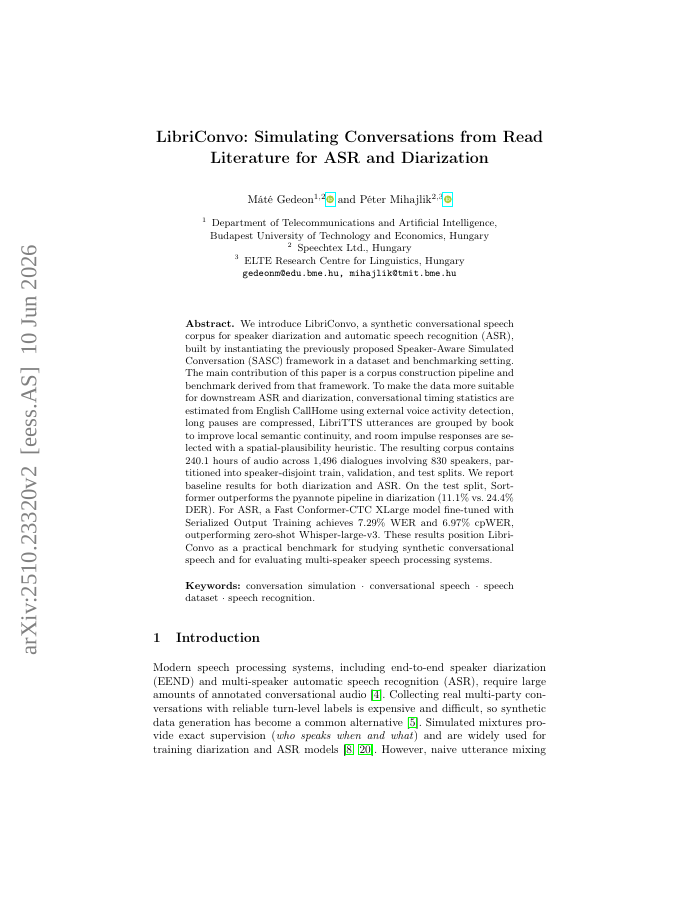
We introduce LibriConvo, a synthetic conversational speech corpus for speaker diarization and automatic speech recognition (ASR), built by instantiating the previously proposed Speaker-Aware Simulated Conversation (SASC) framework in a dataset and benchmarking setting. The main contribution of this paper is a corpus construction pipeline and benchmark derived from that framework. To make the data more suitable for downstream ASR and diarization, conversational timing statistics are estimated from English CallHome using external voice activity detection, long pauses are compressed, LibriTTS utterances are grouped by book to improve local semantic continuity, and room impulse responses are selected with a spatial-plausibility heuristic. The resulting corpus contains 240.1 hours of audio across 1,496 dialogues involving 830 speakers, partitioned into speaker-disjoint train, validation, and test splits. We report baseline results for both diarization and ASR. On the test split, Sortformer outperforms the pyannote pipeline in diarization (11.1% vs. 24.4% DER). For ASR, a Fast Conformer-CTC XLarge model fine-tuned with Serialized Output Training achieves 7.29% WER and 6.97% cpWER, outperforming zero-shot Whisper-large-v3. These results position LibriConvo as a practical benchmark for studying synthetic conversational speech and for evaluating multi-speaker speech processing systems.
LibriConvo: Simulating Conversations from Read Literature for ASR and Diarization
We introduce LibriConvo, a synthetic conversational speech corpus for speaker diarization and automatic speech recognition (ASR), built by instantiating the previously proposed Speaker-Aware Simulated Conversation (SASC) framework in a dataset and benchmarking setting.
- Preview
- Year
- 2025
- Hosting
- Full text hostedCC-BY-4.0
Cite
Notes
Only stored in your browser.
Attribution
- Abstract & full text
- arxiv.org/abs/2510.23320CC-BY-4.0
- TL;DR
- Semantic Scholar