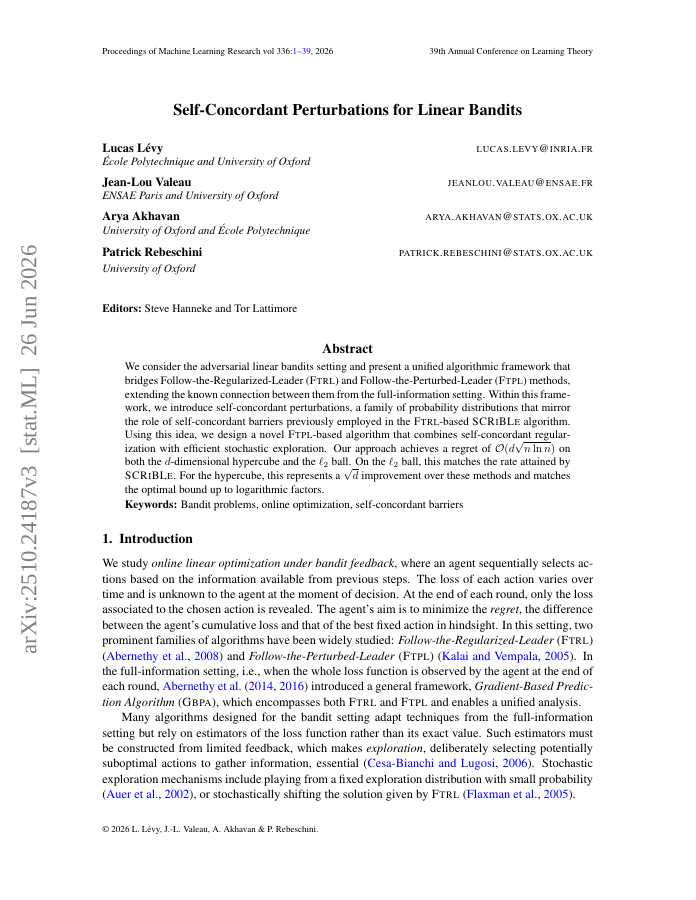
We consider the adversarial linear bandits setting and present a unified algorithmic framework that bridges Follow-the-Regularized-Leader (FTRL) and Follow-the-Perturbed-Leader (FTPL) methods, extending the known connection between them from the full-information setting. Within this framework, we introduce self-concordant perturbations, a family of probability distributions that mirror the role of self-concordant barriers previously employed in the FTRL-based SCRiBLe algorithm. Using this idea, we design a novel FTPL-based algorithm that combines self-concordant regularization with efficient stochastic exploration. Our approach achieves a regret of O(d\sqrt{n \ln n}) on both the d-dimensional hypercube and the \ell_2 ball. On the \ell_2 ball, this matches the rate attained by SCRiBLe. For the hypercube, this represents a \sqrt{d} improvement over these methods and matches the optimal bound up to logarithmic factors.
Self-Concordant Perturbations for Linear Bandits
We consider the adversarial linear bandits setting and present a unified algorithmic framework that bridges Follow-the-Regularized-Leader (FTRL) and Follow-the-Perturbed-Leader (FTPL) methods, extending the known connection between them from the full-information setting.
- Preview
- Year
- 2025
- Hosting
- Full text hostedCC-BY-4.0
Cite
Notes
Only stored in your browser.
Attribution
- Abstract & full text
- arxiv.org/abs/2510.24187CC-BY-4.0
- TL;DR
- Semantic Scholar