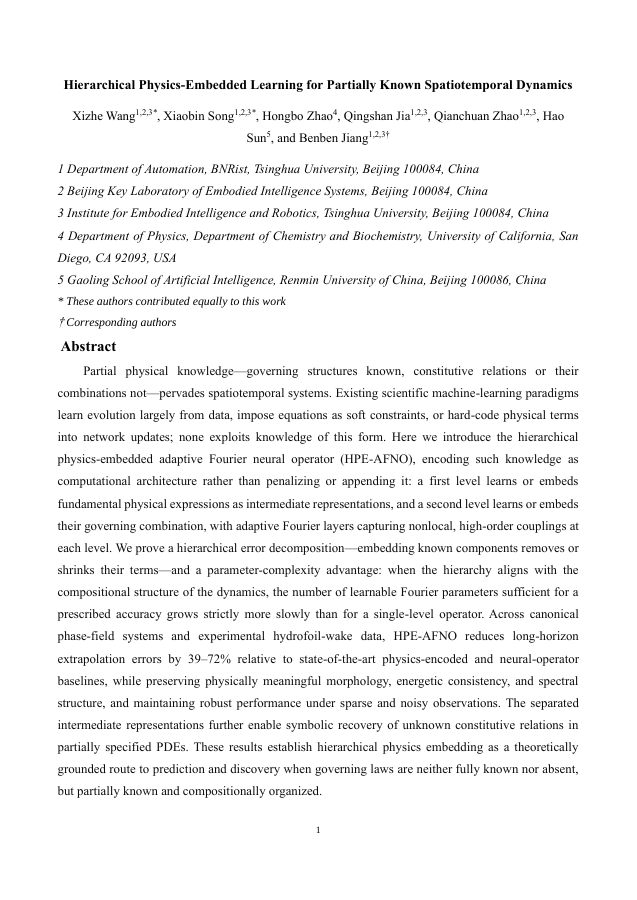
Partial physical knowledge--governing structures known, constitutive relations or their combinations not--pervades spatiotemporal systems. Existing scientific machine learning paradigms learn evolution largely from data, impose equations as soft constraints, or hard-code physical terms into network updates; none exploits knowledge of this form. Here we introduce the hierarchical physics-embedded adaptive Fourier neural operator, encoding such knowledge as computational architecture rather than penalizing or appending it: a first level learns or embeds fundamental physical expressions as intermediate representations, and a second level learns or embeds their governing combination, with adaptive Fourier layers capturing nonlocal, high-order couplings at each level. We prove a hierarchical error decomposition--embedding known components removes or shrinks their terms, and a parameter-complexity advantage: when the hierarchy aligns with the compositional structure of the dynamics, the number of learnable Fourier parameters sufficient for a prescribed accuracy grows strictly more slowly than for a single-level operator. Across canonical phase-field systems and experimental hydrofoil wake data, our method reduces long horizon extrapolation errors by up to 70% relative to state-of-the-art physics encoded and neural operator baselines, while preserving physically meaningful morphology, energetic consistency, and spectral structure, and maintaining robust performance under sparse and noisy observations. The separated intermediate representations further enable symbolic recovery of unknown constitutive relations in partially specified PDEs. These results establish hierarchical physics embedding as a theoretically grounded route to prediction and discovery when governing laws are neither fully known nor absent, but partially known and compositionally organized.
Hierarchical Physics-Embedded Learning for Partially Known Spatiotemporal Dynamics
Partial physical knowledge--governing structures known, constitutive relations or their combinations not--pervades spatiotemporal systems. Existing scientific machine learning paradigms learn evolution largely from data, impose equations as soft constraints, or hard-code…
- Preview
- Year
- 2025
- Hosting
- Excerpt onlyCC-BY-NC-SA-4.0
Cite
Notes
Only stored in your browser.
Attribution
- Abstract & full text
- arxiv.org/abs/2510.25306CC-BY-NC-SA-4.0
- TL;DR
- Semantic Scholar