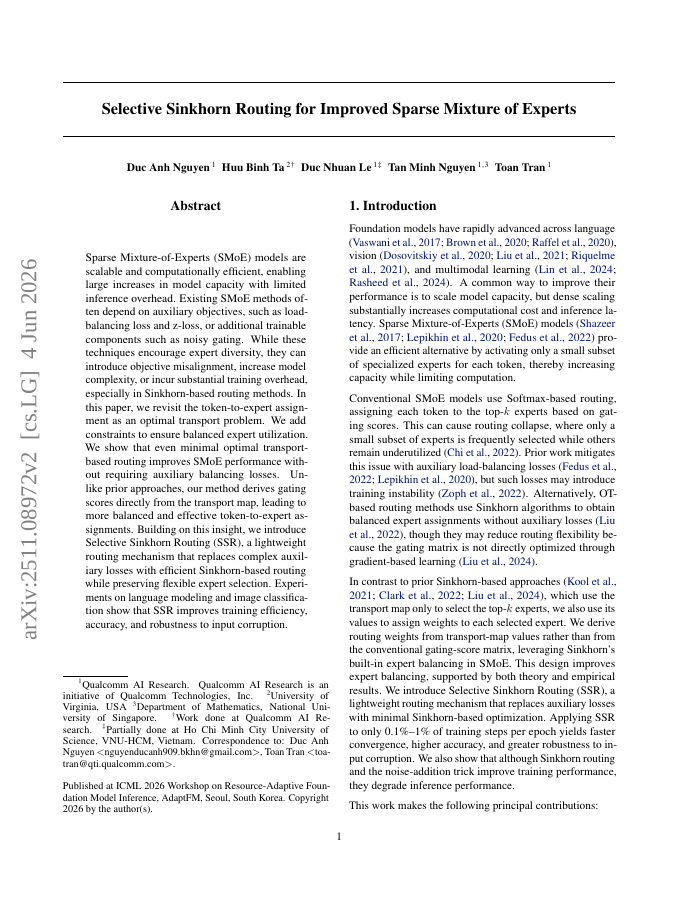
Sparse Mixture-of-Experts (SMoE) models are scalable and computationally efficient, enabling large increases in model capacity with limited inference overhead. Existing SMoE methods often depend on auxiliary objectives, such as load-balancing loss and z-loss, or additional trainable components such as noisy gating. While these techniques encourage expert diversity, they can introduce objective misalignment, increase model complexity, or incur substantial training overhead, especially in Sinkhorn-based routing methods. In this paper, we revisit the token-to-expert assignment as an optimal transport problem. We add constraints to ensure balanced expert utilization. We show that even minimal optimal transport-based routing improves SMoE performance without requiring auxiliary balancing losses. Unlike prior approaches, our method derives gating scores directly from the transport map, leading to more balanced and effective token-to-expert assignments. Building on this insight, we introduce Selective Sinkhorn Routing (SSR), a lightweight routing mechanism that replaces complex auxiliary losses with efficient Sinkhorn-based routing while preserving flexible expert selection. Experiments on language modeling and image classification show that SSR improves training efficiency, accuracy, and robustness to input corruption.
Selective Sinkhorn Routing for Improved Sparse Mixture of Experts
Sparse Mixture-of-Experts (SMoE) models are scalable and computationally efficient, enabling large increases in model capacity with limited inference overhead. Existing SMoE methods often depend on auxiliary objectives, such as load-balancing loss and z-loss, or additional…
- Preview
- Year
- 2025
- Hosting
- Full text hostedCC-BY-4.0
Cite
Notes
Only stored in your browser.
Attribution
- Abstract & full text
- arxiv.org/abs/2511.08972CC-BY-4.0
- TL;DR
- Semantic Scholar