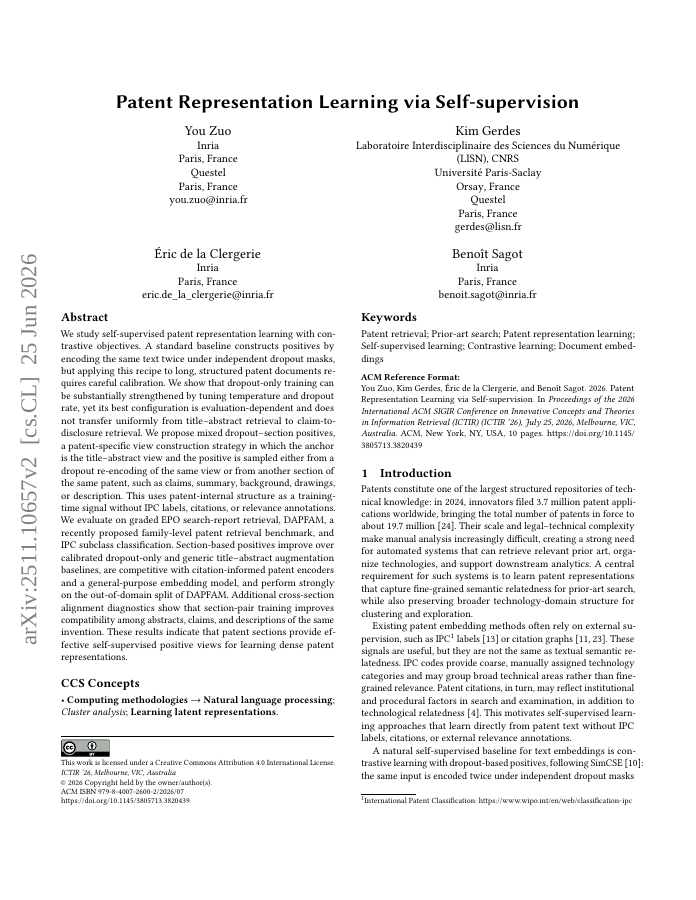
We study self-supervised patent representation learning with contrastive objectives. A standard baseline constructs positives by encoding the same text twice under independent dropout masks, but applying this recipe to long, structured patent documents requires careful calibration. We show that dropout-only training can be substantially strengthened by tuning temperature and dropout rate, yet its best configuration is evaluation-dependent and does not transfer uniformly from title--abstract retrieval to claim-to-disclosure retrieval. We propose mixed dropout--section positives, a patent-specific view construction strategy in which the anchor is the title--abstract view and the positive is sampled either from a dropout re-encoding of the same view or from another section of the same patent, such as claims, summary, background, drawings, or description. This uses patent-internal structure as a training-time signal without IPC labels, citations, or relevance annotations. We evaluate on graded EPO search-report retrieval, DAPFAM, a recently proposed family-level patent retrieval benchmark, and IPC subclass classification. Section-based positives improve over calibrated dropout-only and generic title--abstract augmentation baselines, are competitive with citation-informed patent encoders and a general-purpose embedding model, and perform strongly on the out-of-domain split of DAPFAM. Additional cross-section alignment diagnostics show that section-pair training improves compatibility among abstracts, claims, and descriptions of the same invention. These results indicate that patent sections provide effective self-supervised positive views for learning dense patent representations.
Patent Representation Learning via Self-supervision
We study self-supervised patent representation learning with contrastive objectives. A standard baseline constructs positives by encoding the same text twice under independent dropout masks, but applying this recipe to long, structured patent documents requires careful…
- Preview
- Year
- 2025
- Hosting
- Abstract onlyARXIV-DEFAULT
Cite
Notes
Only stored in your browser.
Attribution
- Abstract & full text
- arxiv.org/abs/2511.10657ARXIV-DEFAULT
- TL;DR
- Semantic Scholar