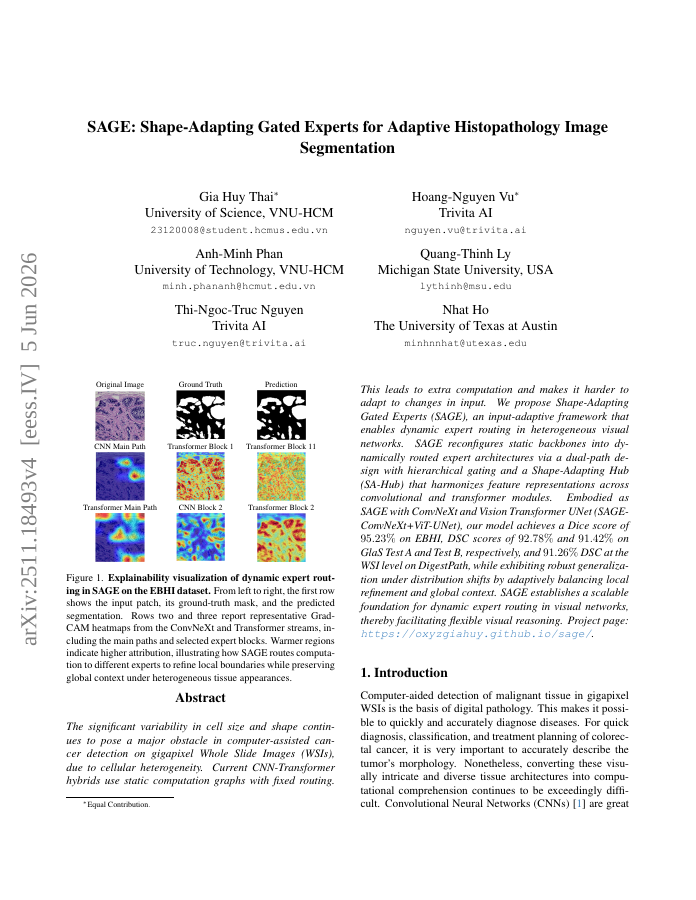
The significant variability in cell size and shape continues to pose a major obstacle in computer-assisted cancer detection on gigapixel Whole Slide Images (WSIs), due to cellular heterogeneity. Current CNN-Transformer hybrids use static computation graphs with fixed routing. This leads to extra computation and makes it harder to adapt to changes in input. We propose Shape-Adapting Gated Experts (SAGE), an input-adaptive framework that enables dynamic expert routing in heterogeneous visual networks. SAGE reconfigures static backbones into dynamically routed expert architectures via a dual-path design with hierarchical gating and a Shape-Adapting Hub (SA-Hub) that harmonizes feature representations across convolutional and transformer modules. Embodied as SAGE with ConvNeXt and Vision Transformer UNet (SAGE-ConvNeXt+ViT-UNet), our model achieves a Dice score of 95.23% on EBHI, DSC scores of 92.78% and 91.42% on GlaS Test A and Test B, respectively, and 91.26% DSC at the WSI level on DigestPath, while exhibiting robust generalization under distribution shifts by adaptively balancing local refinement and global context. SAGE establishes a scalable foundation for dynamic expert routing in visual networks, thereby facilitating flexible visual reasoning. Project page: https://oxyzgiahuy.github.io/sage/
SAGE: Shape-Adapting Gated Experts for Adaptive Histopathology Image Segmentation
The significant variability in cell size and shape continues to pose a major obstacle in computer-assisted cancer detection on gigapixel Whole Slide Images (WSIs), due to cellular heterogeneity. Current CNN-Transformer hybrids use static computation graphs with fixed routing.
- Preview
- Year
- 2025
- Hosting
- Abstract onlyARXIV-DEFAULT
Cite
Notes
Only stored in your browser.
Attribution
- Abstract & full text
- arxiv.org/abs/2511.18493ARXIV-DEFAULT
- TL;DR
- Semantic Scholar