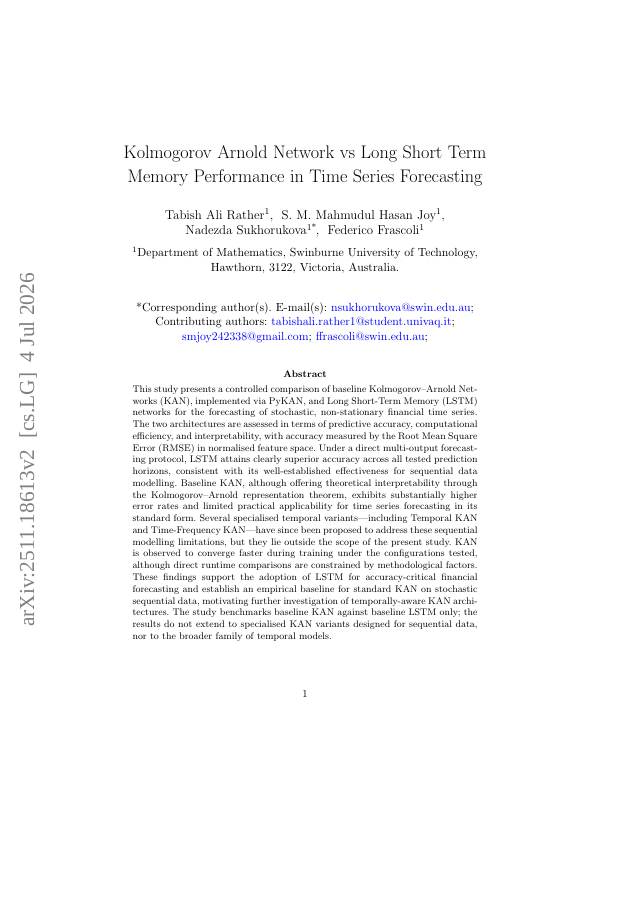
This study presents a controlled comparison of baseline Kolmogorov-Arnold Networks (KAN), implemented via PyKAN, and Long Short-Term Memory (LSTM) networks for the forecasting of stochastic, non-stationary financial time series. The two architectures are assessed in terms of predictive accuracy, computational efficiency, and interpretability, with accuracy measured by the Root Mean Square Error (RMSE) in normalised feature space. Under a direct multi-output forecasting protocol, LSTM attains clearly superior accuracy across all tested prediction horizons, consistent with its well-established effectiveness for sequential data modelling. Baseline KAN, although offering theoretical interpretability through the Kolmogorov-Arnold representation theorem, exhibits substantially higher error rates and limited practical applicability for time series forecasting in its standard form. Several specialised temporal variants -- including Temporal KAN and Time-Frequency KAN -- have since been proposed to address these sequential modelling limitations, but they lie outside the scope of the present study. KAN is observed to converge faster during training under the configurations tested, although direct runtime comparisons are constrained by methodological factors. These findings support the adoption of LSTM for accuracy-critical financial forecasting and establish an empirical baseline for standard KAN on stochastic sequential data, motivating further investigation of temporally-aware KAN architectures. The study benchmarks baseline KAN against baseline LSTM only; the results do not extend to specialised KAN variants designed for sequential data, nor to the broader family of temporal models.
KAN vs LSTM Performance in Time Series Forecasting
This study presents a controlled comparison of baseline Kolmogorov-Arnold Networks (KAN), implemented via PyKAN, and Long Short-Term Memory (LSTM) networks for the forecasting of stochastic, non-stationary financial time series.
- Preview
- Year
- 2025
- Hosting
- Full text hostedCC-BY-4.0
Cite
Notes
Only stored in your browser.
Attribution
- Abstract & full text
- arxiv.org/abs/2511.18613CC-BY-4.0
- TL;DR
- Semantic Scholar