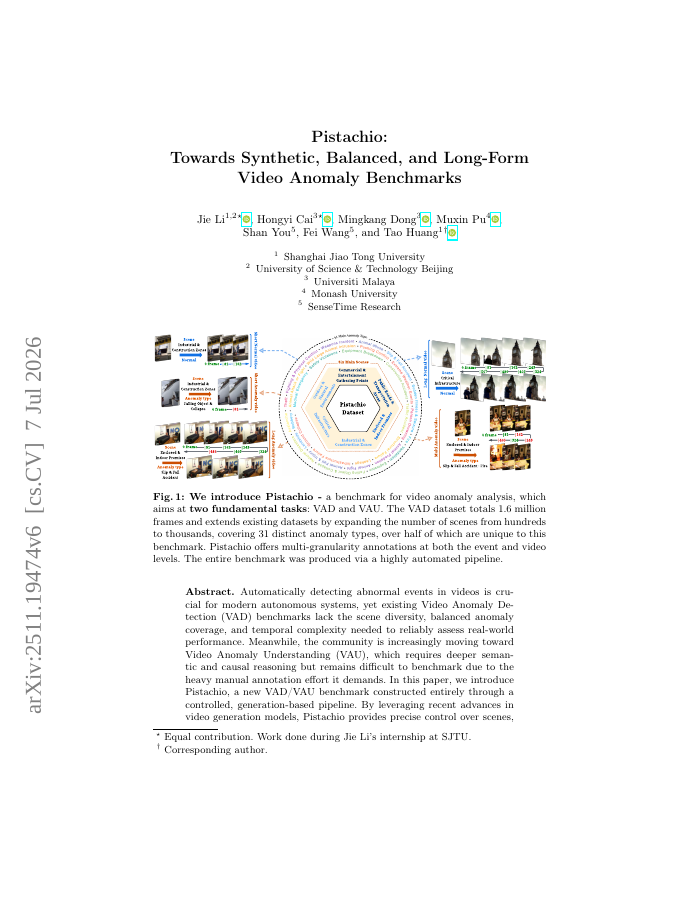
Automatically detecting abnormal events in videos is crucial for modern autonomous systems, yet existing Video Anomaly Detection (VAD) benchmarks lack the scene diversity, balanced anomaly coverage, and temporal complexity needed to reliably assess real-world performance. Meanwhile, the community is increasingly moving toward Video Anomaly Understanding (VAU), which requires deeper semantic and causal reasoning but remains difficult to benchmark due to the heavy manual annotation effort it demands. In this paper, we introduce Pistachio, a new VAD/VAU benchmark constructed entirely through a controlled, generation-based pipeline. By leveraging recent advances in video generation models, Pistachio provides precise control over scenes, anomaly types, and temporal narratives, effectively eliminating the biases and limitations of Internet-collected datasets. Our pipeline integrates scene-conditioned anomaly assignment, multi-step storyline generation, and a temporally consistent long-form synthesis strategy that produces coherent 41-second videos with minimal human intervention. Extensive experiments demonstrate the scale, diversity, and complexity of Pistachio, revealing new challenges for existing methods and motivating future research on dynamic and multi-event anomaly understanding.
Pistachio: Towards Synthetic, Balanced, and Long-Form Video Anomaly Benchmarks
Automatically detecting abnormal events in videos is crucial for modern autonomous systems, yet existing Video Anomaly Detection (VAD) benchmarks lack the scene diversity, balanced anomaly coverage, and temporal complexity needed to reliably assess real-world performance.
- Preview
- Year
- 2025
- Hosting
- Abstract onlyARXIV-DEFAULT
Cite
Notes
Only stored in your browser.
Attribution
- Abstract & full text
- arxiv.org/abs/2511.19474ARXIV-DEFAULT
- TL;DR
- Semantic Scholar