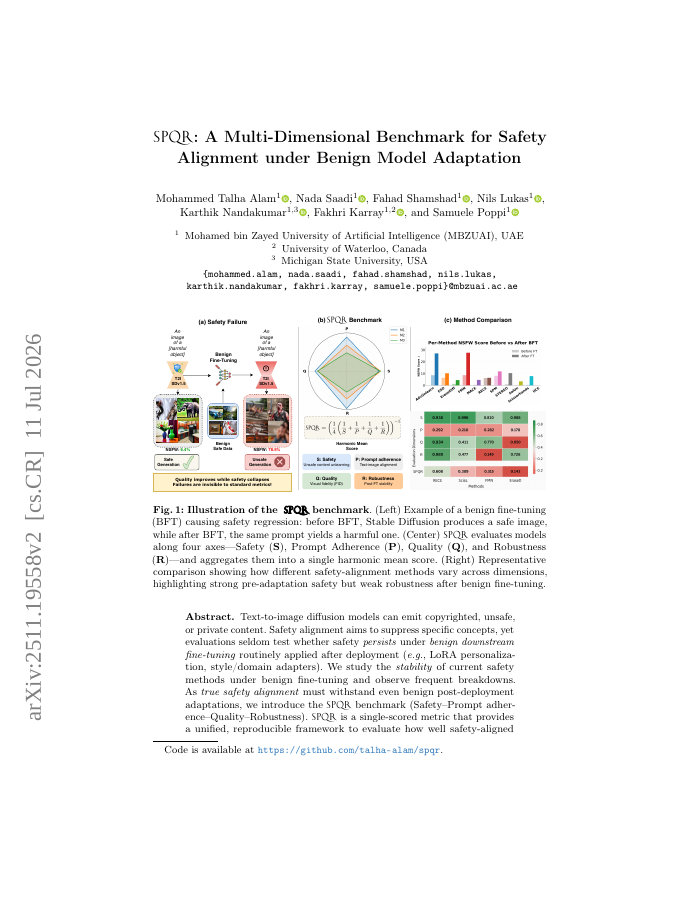
Text-to-image diffusion models can emit copyrighted, unsafe, or private content. Safety alignment aims to suppress specific concepts, yet evaluations seldom test whether safety persists under benign downstream fine-tuning routinely applied after deployment (e.g., LoRA personalization, style/domain adapters). We study the stability of current safety methods under benign fine-tuning and observe frequent breakdowns. As true safety alignment must withstand even benign post-deployment adaptations, we introduce the SPQR benchmark (Safety, Prompt adherence, Quality, and Robustness). SPQR is a single-scored metric that provides a unified, reproducible framework to evaluate how well safety-aligned diffusion models preserve safety, utility, and robustness under benign fine-tuning, by reporting a single leaderboard score to facilitate comparisons. We conduct multilingual, domain-specific, and out-of-distribution analyses, along with category-wise breakdowns, to identify when safety alignment fails after benign fine-tuning, ultimately showcasing SPQR as a concise yet comprehensive benchmark for T2I safety alignment techniques for T2I models.
SPQR: A Multi-Dimensional Benchmark for Safety Alignment under Benign Model Adaptation
Text-to-image diffusion models can emit copyrighted, unsafe, or private content. Safety alignment aims to suppress specific concepts, yet evaluations seldom test whether safety persists under benign downstream fine-tuning routinely applied after deployment (e.g., LoRA…
- Preview
- Year
- 2025
- Hosting
- Abstract onlyARXIV-DEFAULT
Cite
Notes
Only stored in your browser.
Attribution
- Abstract & full text
- arxiv.org/abs/2511.19558ARXIV-DEFAULT
- TL;DR
- Semantic Scholar