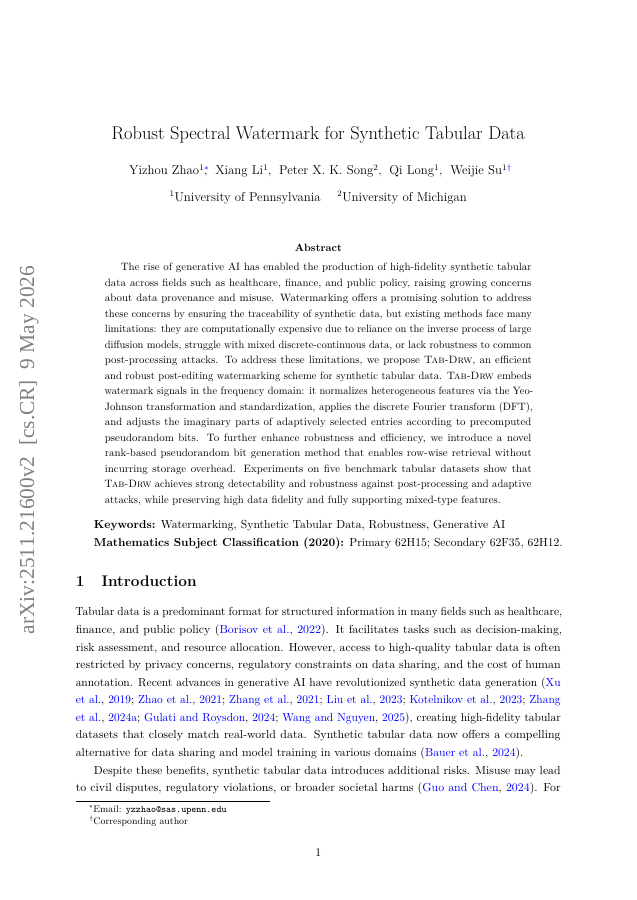
The rise of generative AI has enabled the production of high-fidelity synthetic tabular data across fields such as healthcare, finance, and public policy, raising growing concerns about data provenance and misuse. Watermarking offers a promising solution to address these concerns by ensuring the traceability of synthetic data, but existing methods face many limitations: they are computationally expensive due to reliance on the inverse process of large diffusion models, struggle with mixed discrete-continuous data, or lack robustness to common post-processing attacks. To address these limitations, we propose TAB-DRW, an efficient and robust post-editing watermarking scheme for synthetic tabular data. TAB-DRW embeds watermark signals in the frequency domain: it normalizes heterogeneous features via the Yeo-Johnson transformation and standardization, applies the discrete Fourier transform (DFT), and adjusts the imaginary parts of adaptively selected entries according to precomputed pseudorandom bits. To further enhance robustness and efficiency, we introduce a novel rank-based pseudorandom bit generation method that enables row-wise retrieval without incurring storage overhead. Experiments on five benchmark tabular datasets show that TAB-DRW achieves strong detectability and robustness against post-processing and adaptive attacks, while preserving high data fidelity and fully supporting mixed-type features.
Robust Spectral Watermark for Synthetic Tabular Data
The rise of generative AI has enabled the production of high-fidelity synthetic tabular data across fields such as healthcare, finance, and public policy, raising growing concerns about data provenance and misuse.
- Preview
- Year
- 2025
- Hosting
- Full text hostedCC-BY-4.0
Cite
Notes
Only stored in your browser.
Attribution
- Abstract & full text
- arxiv.org/abs/2511.21600CC-BY-4.0
- TL;DR
- Semantic Scholar