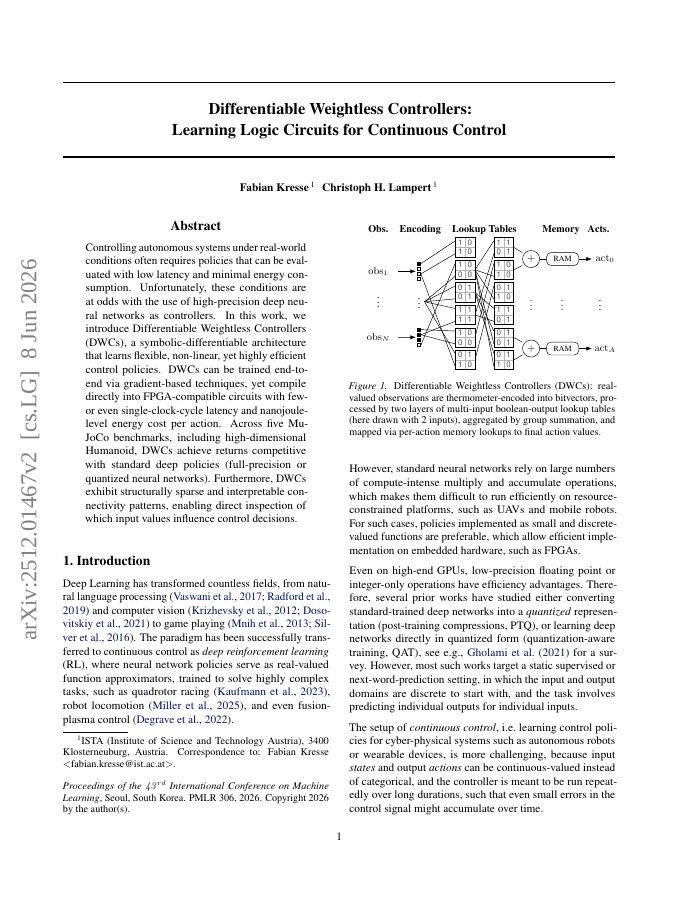
Controlling autonomous systems under real-world conditions often requires policies that can be evaluated with low latency and minimal energy consumption. Unfortunately, these conditions are at odds with the use of high-precision deep neural networks as controllers. In this work, we introduce Differentiable Weightless Controllers (DWCs), a symbolic-differentiable architecture that learns flexible, non-linear, yet highly efficient control policies. DWCs can be trained end-to-end via gradient-based techniques, yet compile directly into FPGA-compatible circuits with few- or even single-clock-cycle latency and nanojoule-level energy cost per action. Across five MuJoCo benchmarks, including high-dimensional Humanoid, DWCs achieve returns competitive with standard deep policies (full-precision or quantized neural networks). Furthermore, DWCs exhibit structurally sparse and interpretable connectivity patterns, enabling direct inspection of which input values influence control decisions.
Differentiable Weightless Controllers: Learning Logic Circuits for Continuous Control
Controlling autonomous systems under real-world conditions often requires policies that can be evaluated with low latency and minimal energy consumption. Unfortunately, these conditions are at odds with the use of high-precision deep neural networks as controllers.
- Preview
- Year
- 2025
- Hosting
- Full text hostedCC-BY-4.0
Cite
Notes
Only stored in your browser.
Attribution
- Abstract & full text
- arxiv.org/abs/2512.01467CC-BY-4.0
- TL;DR
- Semantic Scholar