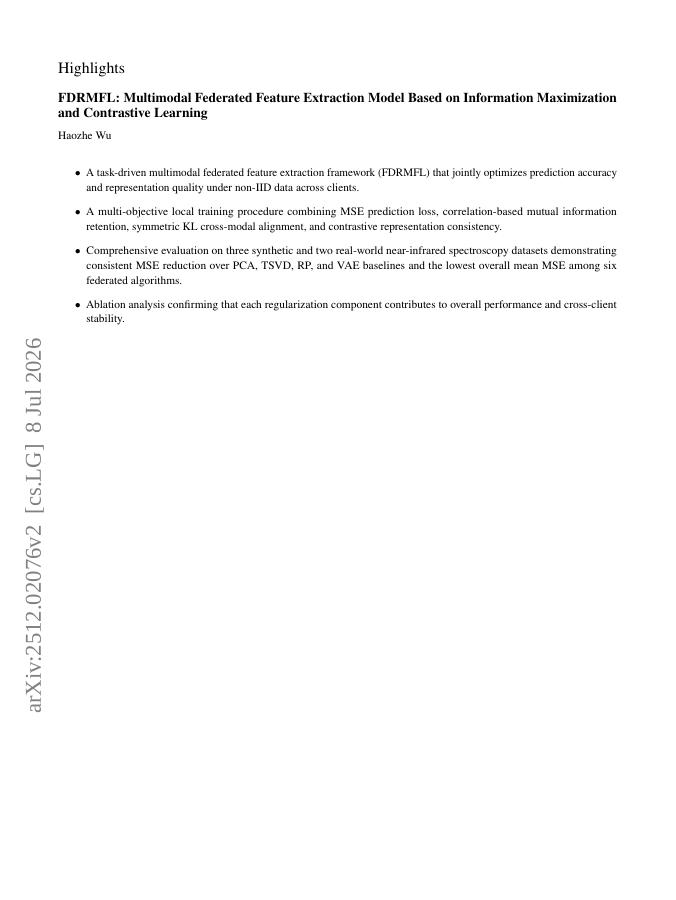
We propose FDRMFL, a task-driven multimodal feature extraction framework for federated regression under non-IID data distributions. Extracting predictive features from high-dimensional multimodal inputs is particularly challenging in this setting: data cannot leave each client, local samples are scarce and heterogeneously distributed, and unsupervised dimensionality reduction discards task-relevant information while federated training introduces representation drift across communication rounds. FDRMFL addresses these challenges through a unified four-term local objective: MSE prediction loss, a correlation-based mutual information surrogate that preserves dependence between the fused representation and the continuous target, a symmetric KL penalty that aligns cross-modal latent distributions before fusion, and an InfoNCE-style contrastive loss that anchors local representations to the global consensus. Experiments on three synthetic and two real-world near-infrared spectroscopy datasets under non-IID federated partitions, with comprehensive ablation and sensitivity analyses, demonstrate that each component contributes to the framework's effectiveness. FDRMFL reduces mean MSE by 33.8% relative to the best traditional baseline (PCA) and by 43.0% relative to VAE in simulation, and attains the lowest overall mean MSE among six federated algorithms including FedAvg, FedProx, MOON, SCAFFOLD, and FedBN.
FDRMFL: Multimodal Federated Feature Extraction Model Based on Information Maximization and Contrastive Learning
We propose FDRMFL, a task-driven multimodal feature extraction framework for federated regression under non-IID data distributions. Extracting predictive features from high-dimensional multimodal inputs is particularly challenging in this setting: data cannot leave each client,…
- Preview
- Year
- 2025
- Hosting
- Full text hostedCC-BY-4.0
Cite
Notes
Only stored in your browser.
Attribution
- Abstract & full text
- arxiv.org/abs/2512.02076CC-BY-4.0
- TL;DR
- Semantic Scholar