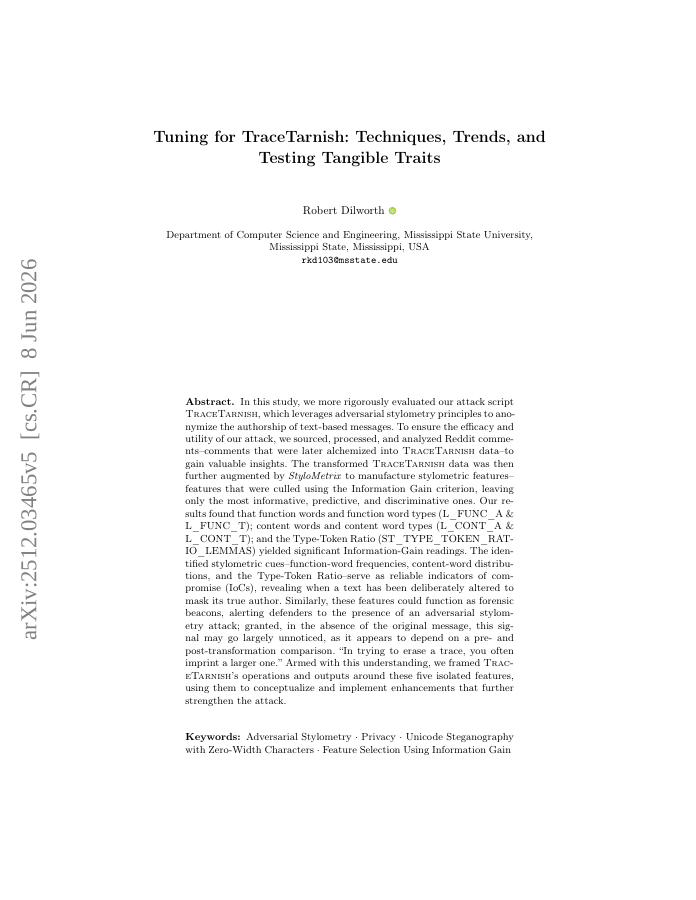
In this study, we more rigorously evaluated our attack script TraceTarnish, which leverages adversarial stylometry principles to anonymize the authorship of text-based messages. To ensure the efficacy and utility of our attack, we sourced, processed, and analyzed Reddit comments -- comments that were later alchemized into TraceTarnish data -- to gain valuable insights. The transformed TraceTarnish data was then further augmented by StyloMetrix to manufacture stylometric features -- features that were culled using the Information Gain criterion, leaving only the most informative, predictive, and discriminative ones. Our results found that function words and function word types (L_FUNC_A & L_FUNC_T); content words and content word types (L_CONT_A & L_CONT_T); and the Type-Token Ratio (ST_TYPE_TOKEN_RATIO_LEMMAS) yielded significant Information-Gain readings. The identified stylometric cues -- function-word frequencies, content-word distributions, and the Type-Token Ratio -- serve as reliable indicators of compromise (IoCs), revealing when a text has been deliberately altered to mask its true author. Similarly, these features could function as forensic beacons, alerting defenders to the presence of an adversarial stylometry attack; granted, in the absence of the original message, this signal may go largely unnoticed, as it appears to depend on a pre- and post-transformation comparison. "In trying to erase a trace, you often imprint a larger one." Armed with this understanding, we framed TraceTarnish's operations and outputs around these five isolated features, using them to conceptualize and implement enhancements that further strengthen the attack.
Tuning for TraceTarnish: Techniques, Trends, and Testing Tangible Traits
In this study, we more rigorously evaluated our attack script $\textit{TraceTarnish}$, which leverages adversarial stylometry principles to anonymize the authorship of text-based messages.
- Preview
- Year
- 2025
- Hosting
- Full text hostedCC-BY-4.0
Cite
Notes
Only stored in your browser.
Attribution
- Abstract & full text
- arxiv.org/abs/2512.03465CC-BY-4.0
- TL;DR
- Semantic Scholar